
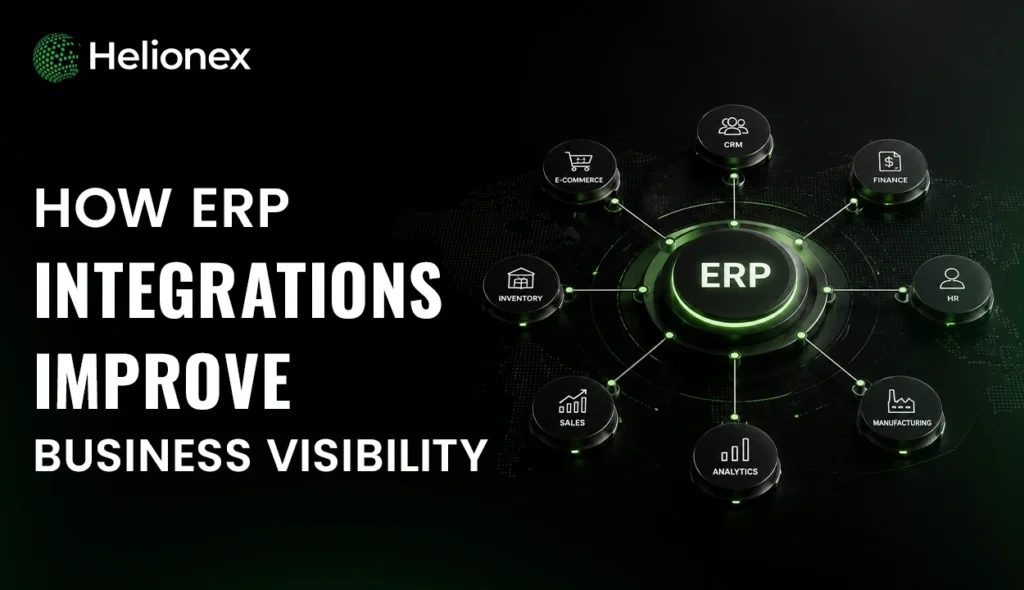
How Do ERP Integrations Improve Business Visibility Across Different Industries?
It is mandatory to understand how ERP integrations improve business visibility. Across different industries, ERP integrations deliver quantifiable value by linking disparate operational systems to offer businesses total visibility into their entire operations. Whether an organization functions within the manufacturing sector, health care field, retail business, logistics industry, financial realm or provides professional services, clarity is paramount.
Manufacturing organizations might combine ERP and supply chain management tools to see raw materials, product schedules, and delivery times in real-time. Retail organizations integrate their ERP and customer relationship management systems (CRM), with their eCommerce platforms to gain total understanding of what product customers want and how many they wish to buy.
Healthcare organizations can view all operations from resources and staff scheduling to finance and supply purchases with ERP integrations. And businesses focused on providing services to their customers use their ERP integrations to unite project management software with financial software and client management systems.
In every industry, though, the basic ERP integration benefit remains clear – companies see the most critical information in real time, not scattered throughout disconnected documents.
What Business Systems Can Be Connected Through ERP Integration?
An ERP integration solution establishes a data flow from an organization’s ERP system to existing tools and systems. The objective is to provide a consistent experience for accessing and sharing information across all the applications.
Common ERP integrations that organizations use include:
- Customer Relationship Management (CRM) system
- ECommerce platform
- Business Intelligence (BI) tools
- Accounting and financial software
- Supply chain management (SCM) system
- Warehouse management system (WMS)
- Human Resource Management (HRM) system•Payment gateway
- Marketing automation platform
- Third-party business software for the enterprise
An example of how an ERP can be integrated is when sales staff, through CRM integration with an ERP system, obtain insight into purchasing history, stock levels, customer history, or spending patterns of customers.
For businesses looking for a flexible ERP foundation, Helionex provides Odoo ERP implementation services that help organizations centralize their operations. Odoo enables businesses to connect sales, inventory, accounting, CRM, and other essential processes within one integrated platform, improving visibility and operational control.
Integration with BI tools helps organizations transform data and reports from various departments into visually intuitive dashboards that support strategic decision-making. This is one of the key ways how ERP integrations improve business visibility, enabling leaders to access accurate insights from across the organization. Choosing the best ERP integration strategy depends on an organization’s objectives, existing infrastructure, and long-term roadmap for scaling and growth.
How Does ERP Integration Create Real-Time Reporting and Analytics?
Traditionally employees have to draw reports from multiple disparate systems, merge different spreadsheets and then compile individual reports by hand. The report will then naturally and inherently take employees many more working hours to complete than would otherwise need to be invested and has more chances for error than a system would have.
ERP integration makes reporting more straightforward by extracting data from your various systems and providing it in one consolidated place so that all of the data can be collected and maintained at the same time.
Business can have real-time reports on their revenue, inventory, demand for products, performance of its operations and its finances, supply chain operations, and the effectiveness of employees with real-time analytics that enable them to see problem areas before they get any bigger and thus react faster.
For enterprise-level organizations managing complex operations, Helionex offers Microsoft Dynamics 365 Finance & Operations implementation to create a connected business environment. The platform helps businesses unify finance, supply chain, and operational data, allowing leadership teams to access real-time insights and make informed strategic decisions.
This in turn helps business managers and their staff to use proactive instead of reactive data to guide business decisions.
What Are the Main Challenges of Implementing ERP Integrations?
Integrating with an ERP can deliver significant business value, but achieving these results requires careful planning and a well-defined strategy. Understanding how ERP integrations improve business visibility starts with recognizing the complexity of connecting multiple systems and ensuring they work seamlessly together. Without proper preparation, businesses may face challenges such as:
System Compatibility:
Concerns disparate systems can’t always easily communicate due to differing data structures, technological requirements or communication standards.
Careful planning:
During ERP implementation is necessary to facilitate successful integration.
Security and Compliance:
Concerns Security is paramount during information exchange, so businesses should define strict security measures, authentication and access controls when implementing.
ERP integration:
Changes to Existing Workflows Even with enhanced processes, the people using the systems must be trained for the new workflow, new report structure and updated features.
Ongoing Maintenance:
It’s essential to remember that ERP integration isn’t a single project.
As businesses grow and technology advances, new updates and maintenance processes are inevitable.
When organisations work with skilled integration experts, they can significantly decrease their chances of facing these risks and develop an integration strategy they can rely on.
How Much Does ERP Integration Cost and What Factors Affect Pricing?
ERP integration costs can vary depending on the complexity of the implementation, number of applications being connected, and the degree of customization needed. Factors affecting cost. Among the factors that impact cost of ERP integration are:
- Number of apps being linked
- Data migration need
- Development of custom workflow
- API capability
- Security requirement
- Test of integrations
- Maintenance cost requirement
Two or more of the modern application on cloud could possibly costs much lower in relation to connecting several departments’ or any organizations’ enterprise system. ERP integration must view as an extended term investment, and then your firm would have to get benefits from visibility, reduced manual efforts, quick decision making, and improved efficiency etc.

How Long Does ERP Integration Take to Complete?
The timing of an ERP integration project can vary widely, depending on its scale and technical sophistication. While small, straightforward integration can sometimes be completed within a few weeks, complex enterprise integrations can take several months to deploy.
Some of the key drivers that influence implementation time include:
- The number of systems being integrated
- The complexity of data to be migrated Customization needs
- Required levels of testing business sign-off Training employees
- Business requirement definition System analysis Integration strategy
- Design and configuration
- Quality Assurance
- Testing System implementation
- Continuous improvements.
Having a clearly defined roadmap for the integration project allows businesses to mitigate risks, and ensure the desired benefits from the integration can be achieved.
How Can Businesses Choose the Right ERP Integration Partner?
ERP integration implementation timelines. The implementation time for an ERP integration project is typically measured by the project’s scope and technical complexity. A small, basic integration might be completed in just a couple of weeks, whereas extensive enterprise integrations could take several months.
Several factors typically contribute to an implementation timeframe including:
- How many different systems will be integrated?
- How complex is the data to migrate Customizations
- Required tests Business sign-off Training for users
A robust process for an ERP integration is generally structured as follows:
- Business Requirements
- Definition Analysis of the System Integration
- Strategy Design & Configuration
- QA & Testing System
- Deployment Continuous Improvement.
A clear roadmap for ERP integration ensures that business objectives are achieved while risks are effectively identified and controlled. By understanding how ERP integrations improve business visibility, businesses can create a structured integration strategy that connects systems, enhances data accuracy, and supports better decision-making.
Why Choose Helionex as Your ERP Integration Partner?
Helionex provides connected technology environment expertise to help businesses understand how ERP integrations improve business visibility by enhancing data connectivity, improving operational efficiency, and enabling smarter, faster decision-making.
Helionex works to first understand your business and then provide ERP integration solution that support your goals.
Business trust Helionex with ERP integration, we focus on:
Business-Centered Integration Solutions
Helionex believes that integration projects should be more than just technical. We strive to understand your business and demonstrate how connected systems can enhance reporting, workflows and business control.
Flexible Integration Solution Options
Helionex recognizes each business is unique. Whether it be a business on the move and anticipating future growth or the steady growing business Helionex has an integration plan for everyone.
Data Integrity
Helionex has assisted businesses in eliminating data inconsistency. Through establishing a clear path for your data, Helionex delivers information your employees can trust.
Lowering Your Total Cost of Operations
Helionex uses integration automation to reduce manual efforts. Our solutions eliminate routine tasks and maximize resource availability.
Ongoing System Support
Integrating systems can be the first step. Helionex is a partner who is there for the long haul to assist your business in optimizing systems for continued growth and efficiencies.
What Is the Future of ERP Integration and Business Visibility?
Future ERP integration trend Towards smarter, more connected business ecosystems Businesses have been adopting to:
Cloud-hosted ERPs
Artificial intelligence enhanced analytics
Automated workflows enhanced reporting systems.
Connected digital ecosystems
In order to compete in data-generating age, it would have to look to become a leader in data and integration strategy that makes your data visible. Successful systems integration will have tighter control of operations and allow better decision-making to gain faster competitive advantages
ERP integration is no longer only about connecting software; it is about creating an intelligent foundation where businesses can understand performance, predict challenges, and make better strategic decisions. By exploring how ERP integrations improve business visibility, organizations can unlock real-time insights, streamline operations, and build a more connected approach to growth.
Conclusion: Why ERP Integration Is Essential for Better Business Visibility
Knowing that an ERP integration can boost a business’s visibility is a critical aspect that can inspire businesses to learn the true power of interconnected systems and platforms. Unfortunately, businesses cannot rely on disconnected tools or reporting. Businesses must invest in integration software that provides reliable and accurate data for better cooperation, faster and clearer decision making, and more streamlined reporting functions.
When it’s time for your company to transition from separate, disjointed systems to a scalable digital infrastructure for business success, working with an established. ERP integration partner, like Helionex, will create more opportunities for growth by improving overall visibility.

Frequently Asked Questions About ERP Integrations and Business Visibility
How do ERP integrations improve business visibility?
ERP integrations provide greater business visibility, by enabling various business functions to be linked to provide accurate, organized and real-time data to business managers so that they may understand business performance, make reports more effective and clear up operations for business.
Why data are silos a problem for businesses?
With data silos, each departmental silo shares no information with another silo. If your data silos contribute to a variety of issues, your organization will face problems ranging from reporting errors and poor decision-making to redundant tasks and less efficient operations.
Can ERP integration work with existing business software?
Certainly, ERP integration has numerous integration with various existing platforms, e.g., ERP and CRM, ERP and the e-commerce store, as well as the existing ERP integration with accounting software, etc.
Is ERP integration only useful for large companies?
No. Any size company can reap ERP integration benefits. For growing small and medium-sized businesses, better efficiency, less manual work, and more clarity can help keep things manageable.
How do ERP integrations support better decision-making?
With accurate, real-time ERP data, leaders can detect trends, assess performance, and make better-informed decisions.