When it comes to building or upgrading your IT systems like Cloud vs On-Premise Infrastructure, one question always comes up:Should we go with cloud or stick to on-premise infrastructure?It’s not just a technical decision. It directly impacts your costs, flexibility, security, and even how fast your business can grow.That’s why understanding Cloud vs On-Premise Infrastructure: …
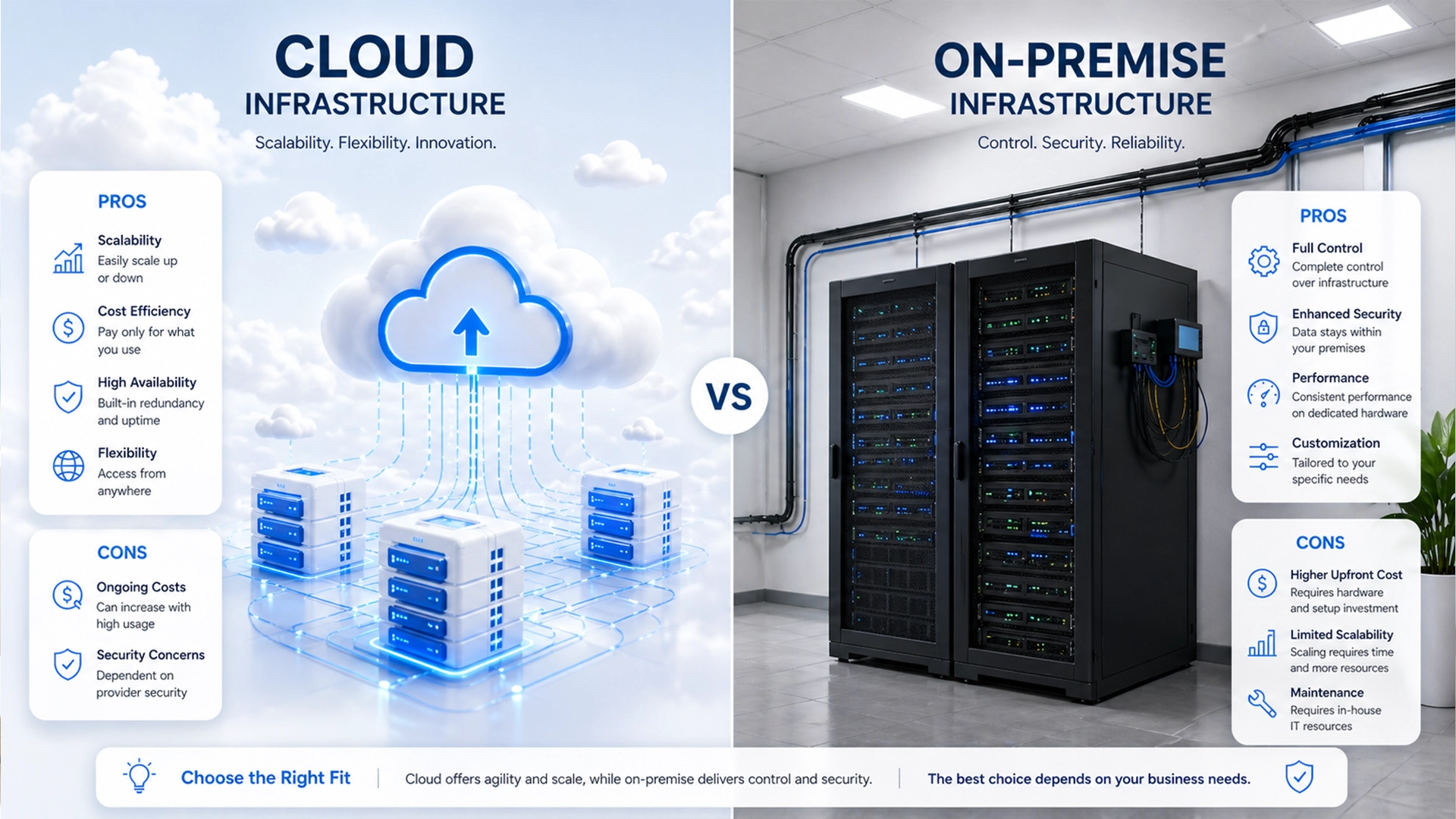
When it comes to building or upgrading your IT systems like Cloud vs On-Premise Infrastructure, one question always comes up:
Should we go with cloud or stick to on-premise infrastructure?
It’s not just a technical decision. It directly impacts your costs, flexibility, security, and even how fast your business can grow.
That’s why understanding Cloud vs On-Premise Infrastructure: Pros & Cons is so important. There’s no one-size-fits-all answer—but there is a right answer for your business.
In this guide, we’ll break everything down in simple terms so you can make a confident, informed decision.
What Is Cloud Infrastructure?
Cloud infrastructure refers to virtual IT resources such as servers, storage, databases, networking, and software that businesses access through the internet. Instead of buying and maintaining physical hardware, companies use cloud platforms to run applications, store data, and manage operations more flexibly.
When comparing Cloud vs On-Premise Infrastructure, cloud offers faster setup, easier scalability, and lower upfront costs. It is especially useful for growing businesses, remote teams, and companies that need quick access to secure digital resources. However, businesses must still manage cloud costs, security settings, and provider dependency carefully.
Cloud infrastructure means your systems—like servers, storage, and applications—run online instead of sitting physically in your office.
Instead of buying hardware, you use services from providers like AWS, Microsoft Azure, or Google Cloud. You access everything through the internet. Think of it like renting instead of owning. You only pay for what you use, and you can scale up or down whenever needed.
If you want to implement or upgrade your cloud environment, professional support can make a huge difference. At Helionex, our Cloud Infrastructure Services help businesses design, deploy, and manage scalable cloud systems with better performance, security, and cost control. We focus on building reliable cloud setups that match your business needs instead of offering one-size-fits-all solutions.
What Is On-Premise Infrastructure?
Everything is under your control.
But with that control comes responsibility. Your team handles maintenance, updates, security, and repairs.
Think of it like owning a house, you have full control, but you also handle everything yourself.
Cloud vs On-Premise Infrastructure: Quick Comparison
When comparing Cloud vs On-Premise Infrastructure, the main difference is ownership and control. Cloud infrastructure runs through internet-based platforms, while on-premise infrastructure uses physical servers managed by your own business.
Cloud is usually faster to set up, easier to scale, and better for remote access. On-premise infrastructure offers more control, stronger customization, and predictable performance for stable workloads. The right choice depends on your budget, security needs, IT resources, and long-term growth plans. Many businesses also choose hybrid cloud to balance flexibility with control.
Here’s a simple way to understand the difference:
Factor | Cloud | On-Premise |
Cost | Pay monthly (OpEx) | High upfront cost (CapEx) |
Setup | Fast | Slow |
Scalability | Very flexible | Limited |
Control | Shared | Full |
Maintenance | Mostly handled | Fully your responsibility |
Security | Shared responsibility | Fully internal |
Remote access | Easy | Needs setup |
Best for | Growth & flexibility | Control & stability |
Advantages of Cloud Infrastructure
Businesses can increase storage, computing power, or application capacity whenever demand grows. Another major advantage is easier backup and disaster recovery, helping companies protect data and reduce downtime.
Lower Upfront Cost
You don’t need to invest heavily in hardware. This is a huge benefit for startups and growing companies.
Scalability on Demand
Need more storage or computing power? You can scale instantly. No waiting, no hardware upgrades.
Faster Setup
You can launch systems in hours instead of weeks.
- Remote Accessibility
Your team can work from anywhere securely. Perfect for hybrid or remote teams.
Built-In Backup Options
Cloud platforms offer backup and disaster recovery features that are easier to manage than traditional setups.

Disadvantages of Cloud Infrastructure
Cloud vs On-Premise Infrastructure also highlights some cloud challenges. Cloud infrastructure has many benefits, but ongoing cost management can become a major issue. If usage is not monitored, monthly cloud bills can increase quickly. Businesses also depend on a stable internet connection to access cloud systems.
Another concern is vendor lock-in, where moving from one cloud provider to another can become difficult. Security is also a shared responsibility, so companies must manage access, passwords, data protection, and system settings carefully.
Cloud isn’t perfect, and it’s important to understand the trade-offs.
Ongoing Costs Can Grow
If not managed properly, your monthly bills can increase quickly.
Vendor Lock-In
Switching providers later can be difficult and expensive.
Internet Dependency
If your connection goes down, access to systems can be affected.
Shared Security Responsibility
The provider secures the platform, but you’re responsible for configurations, access, and data protection.
Advantages of On-Premise Infrastructure
For stable workloads, on-premise systems can deliver consistent performance without depending heavily on third-party providers. Another advantage is predictable control over data storage, access rules, and internal processes, which can be important for enterprises with complex IT requirements.
Despite the rise of cloud, on-premise still has strong use cases.
- Full Control
You control everything—hardware, software, security, and access.
- Deep Customization
You can tailor systems exactly to your needs.
- Consistent Performance
No shared environments. Performance remains stable.
- Data Ownership
All sensitive data stays within your infrastructure.
Disadvantages of On-Premise Infrastructure
It also needs ongoing maintenance, updates, security monitoring, and hardware replacement. Scaling can take time, as new equipment must be purchased and installed. Businesses also need skilled IT staff to manage daily operations and solve technical issues. Disaster recovery can become more complex because backups, failover systems, and recovery plans must be handled internally.
- High Initial Investment
Servers, storage, networking it all adds up.
- Limited Scalability
Scaling requires buying and installing new hardware.
- Maintenance Responsibility
Your IT team must manage everything.
- Complex Disaster Recovery
You need proper backup systems and recovery planning.
Cloud vs On-Premise Infrastructure: Cost Breakdown
When comparing Cloud vs On-Premise Infrastructure, cost depends on setup, usage, maintenance, and long-term growth. Cloud infrastructure usually has lower upfront costs because businesses pay monthly or based on usage. However, costs can increase with storage, traffic, backups, and extra services.
On-premise infrastructure requires a larger upfront investment in servers, licenses, space, power, and IT staff. However, it may offer more predictable costs for stable workloads. The best choice depends on total cost of ownership, not just the starting price.
Cost is often the biggest deciding factor.
Cloud follows a pay-as-you-go model, while on-premises requires a large upfront investment.
Cloud Costs Include:
- Storage and computing
- Data transfer
- Backup and recovery
- Security tools
- Support services
On-Premise Costs Include:
- Hardware and servers
- Software licenses
- IT staff salaries
- Power and cooling
- Maintenance and upgrades
 Key Insight:
Cloud seems cheaper at first, but without proper management, it can become expensive.
On-premise costs more upfront but can be stable over time.
Security & Compliance: Which Is Safer?
On-premise infrastructure gives companies full control over security policies, data storage, and access rules. This can help businesses with strict compliance needs. The safer option depends on your industry, internal IT skills, data sensitivity, and how well your security processes are managed.
This is where many businesses hesitate.
The truth?
Both can be secure—if managed properly.
- Cloud offers advanced security tools and certifications
- On-premises gives you full control over data and access
Your decision should depend on:
- Compliance requirements
- Data sensitivity
- Internal IT expertise
Security plays a critical role in both cloud and on-premise environments. Helionex provides advanced Network Monitoring & Security Services to help businesses detect threats, monitor network activity, and strengthen overall infrastructure protection.
This ensures your systems remain secure, compliant, and continuously monitored against risks and vulnerabilities.
Scalability & Performance
- Cloud = Best for rapid growth and changing demand
- On-Premise = Best for stable and predictable workloads
If your business is growing fast, cloud is usually the better option.
If your systems rarely change, on-premises might make more sense.

What About Hybrid Cloud?
This approach gives companies more control without losing the flexibility of cloud services. Hybrid cloud is especially useful for businesses with compliance needs, legacy systems, or gradual migration plans.
It can also reduce risk because companies do not need to move everything at once. For many organisations, hybrid cloud offers the best balance between security, control, cost, and scalability.
You keep sensitive data on-premise, but use the cloud for:
- Backups
- Applications
- Remote access
- Scaling
For many businesses, this is the most practical solution.
How to Choose the Right Option
You should also consider your internal IT team, migration risks, maintenance workload, and long-term costs. For many businesses, the best option is hybrid cloud because it balances control with flexibility while supporting future growth.
Choosing the right infrastructure is not only a technology decision. It is a long-term business decision that affects cost, performance, security, and growth.
At Helionex, we help businesses avoid costly mistakes by recommending solutions that match their real needs. We do not push cloud blindly, and we do not force outdated systems. Instead, we study your current setup, business goals, risks, and budget before suggesting the right path.
Our services include:
- Cloud infrastructure strategy
- On-premise optimization
- Hybrid cloud planning
- Cloud migration support
- Managed IT services
- Security and compliance consulting
- Cost optimization
With Helionex, you get a practical infrastructure plan built around your business, not a one-size-fits-all solution.
Conclusion
Understanding Cloud vs On-Premise Infrastructure: Pros & Cons helps you make smarter business decisions.
Cloud offers flexibility, speed, and scalability.
On-premise offers control, stability, and customisation.
And for many businesses, hybrid cloud brings the best of both worlds.
There’s no universal answer—but there is a right strategy for you.
With the right guidance, you can choose an infrastructure that supports your growth, reduces risk, and saves money in the long run.
FAQs
Which is better: cloud or on-premise?
It depends on your needs. Cloud is better for flexibility and growth, while on-premises is better for control and stability.
Is cloud always cheaper?
Not always. Cloud can become expensive if not managed properly.
Can I use both cloud and on-premise?
Yes, that’s called hybrid cloud—and it’s often the best option.
Is cloud secure?
Yes, but only if configured correctly and managed properly.
Who should use on-premise infrastructure?
Businesses with strict compliance needs, stable workloads, or sensitive data.
How can Helionex help?
Helionex helps you evaluate, plan, and implement the best infrastructure strategy based on your business goals.