What is ERP? Enterprise Resource Planning (ERP) is a comprehensive business software solution that integrates core processes across finance, human resources (HR), supply chain, customer relationship management (CRM), and analytics into a single platform.Modern businesses leverage ERP to eliminate silos, gain real-time insights, automate workflows, and improve ROI by streamlining operations. ERP has evolved from …
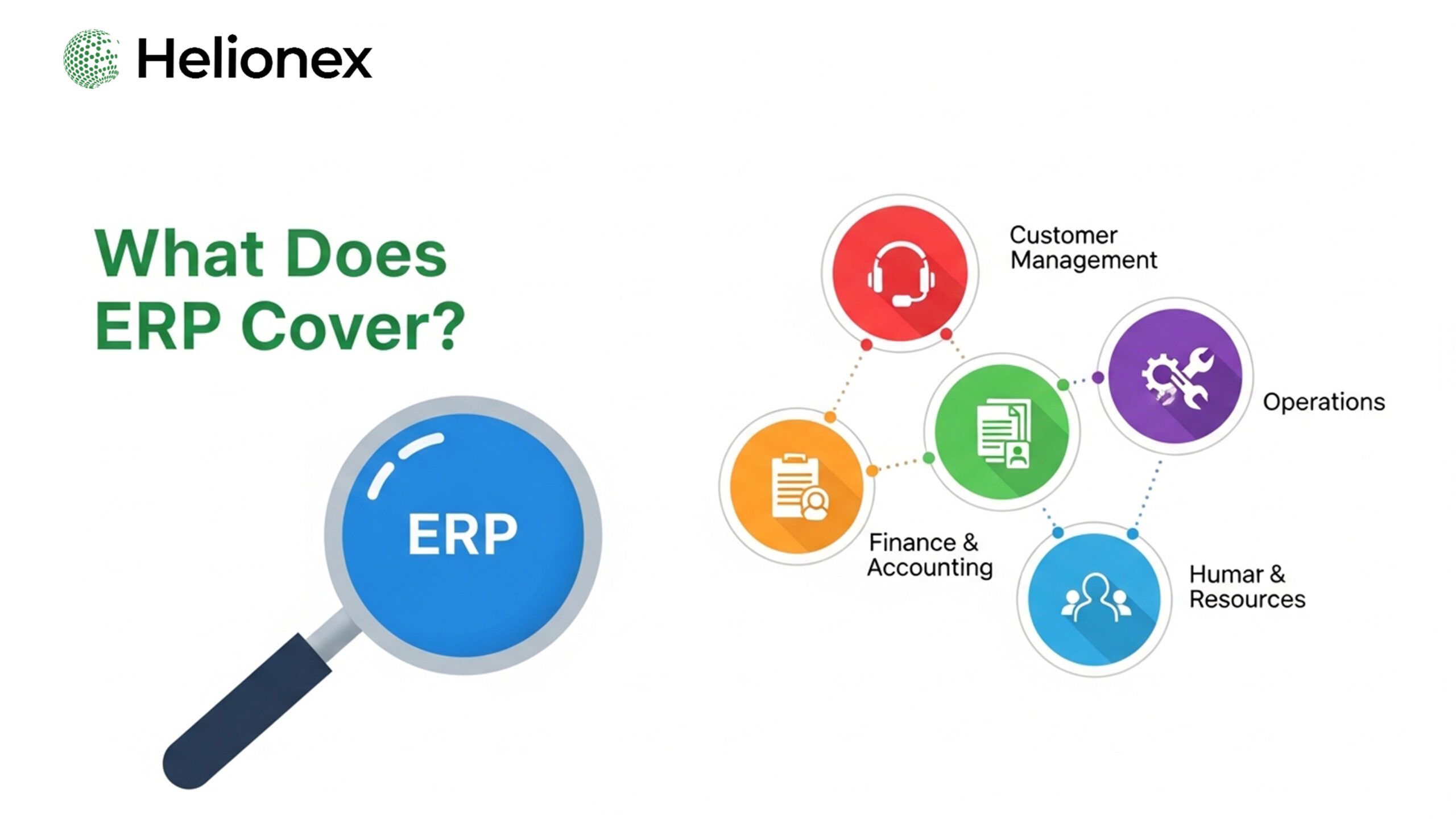
What is ERP? Enterprise Resource Planning (ERP) is a comprehensive business software solution that integrates core processes across finance, human resources (HR), supply chain, customer relationship management (CRM), and analytics into a single platform.
Modern businesses leverage ERP to eliminate silos, gain real-time insights, automate workflows, and improve ROI by streamlining operations. ERP has evolved from traditional on-premise systems to cloud-based platforms enriched with AI, analytics, and mobile accessibility.
ERP (Enterprise Resource Planning) is an integrated software platform that centralizes business operations including finance, HR, supply chain, and CRM providing real-time insights, workflow automation, and cross-department collaboration to enhance efficiency, scalability, and decision-making.
This guide will explain ERP in detail, explore types, modules, benefits, implementation best practices, and highlight why Helionex is the ideal ERP partner.
Why ERP Matters in Modern Businesses
Understanding what is ERP is critical for modern businesses. ERP centralizes finance, HR, supply chain, and CRM on a single platform, reducing silos and enabling real-time insights. It automates tasks, improves reporting, and enhances forecasting, saving time and lowering costs.
ERP also boosts collaboration across departments, providing a single source of truth for decision-making. Modern systems include AI-powered analytics and predictive tools, helping leaders identify trends, prevent bottlenecks, and maximize ROI.
From manufacturing to healthcare and retail, ERP transforms data into actionable insights, streamlines operations, and supports scalable growth. In short, ERP is not just software—it’s a strategic tool that drives efficiency, agility, and long-term business success.
Centralization and Data Integration
A centralized ERP ensures all departments work from a single source of truth, reducing duplication, errors, and delays. Centralized data improves decision-making, supports KPI tracking, and enables predictive analytics for future business planning.
Operational Efficiency and Collaboration
ERP connects finance, HR, sales, procurement, and supply chain teams, fostering seamless collaboration. Automation reduces repetitive tasks, accelerates workflows, and allows employees to focus on strategic initiatives.
Types of ERP Systems
When exploring what is ERP, it’s important to understand the different types of ERP systems available. Choosing the right type depends on your business size, industry, and operational needs.
- On-Premise ERP: Installed locally, offering full customization and control. Ideal for companies with strict compliance or security requirements.
- Cloud ERP: Hosted online via SaaS, scalable, accessible anywhere, with automatic updates and lower upfront costs. Perfect for businesses seeking flexibility and fast deployment.
- Hybrid ERP: Combines on-premise and cloud features, allowing sensitive modules to remain internal while others leverage cloud benefits.
- Industry-Specific ERP: Tailored solutions for sectors like manufacturing, healthcare, retail, finance, or logistics, including specialised modules and workflows.
Understanding the types of ERP helps organizations select the system that best aligns with their goals, operational complexity, and growth plans, ensuring maximum ROI and efficiency.
Core ERP Modules and Their Functions
Understanding what is ERP requires looking at its core modules, each designed to streamline specific business operations. The Finance module manages budgeting, accounting, cash flow, and compliance, enabling real-time reporting for better decision-making.
Human Resources (HR) handles payroll, employee records, performance management, and compliance tracking, helping businesses optimize workforce planning and efficiency. Inventory and Procurement monitors stock levels, automates orders, and manages supplier relationships to ensure smooth supply chain operations.
The Sales and CRM module tracks customer interactions, manages sales pipelines, and supports marketing campaigns, improving customer engagement and revenue. Finally, Analytics and Business Intelligence (BI) provides dashboards, KPI monitoring, and predictive insights to guide strategic planning and performance tracking.
Together, these modules centralise data, eliminate silos, automate processes, and empower businesses to make informed, data-driven decisions while scaling efficiently.
Module | Purpose / Value | Example Entity / Tool |
Finance | Accounting, budgeting, compliance, cash flow | SAP FI, Oracle NetSuite |
HR | Payroll, employee records, performance tracking | Workday HCM |
Inventory & Procurement | Stock management, vendor management, procurement | SAP MM, Oracle SCM |
Sales & CRM | Customer tracking, pipeline management, marketing insights | Salesforce, Zoho CRM |
Analytics & BI | KPI dashboards, predictive analytics, reporting | Power BI, Tableau |
Semantic entities: ERP modules, cloud ERP, on-premise ERP, industry ERP, SaaS ERP, AI-powered ERP, predictive analytics, KPI dashboards, workflow automation.
How ERP Transforms Business Operations
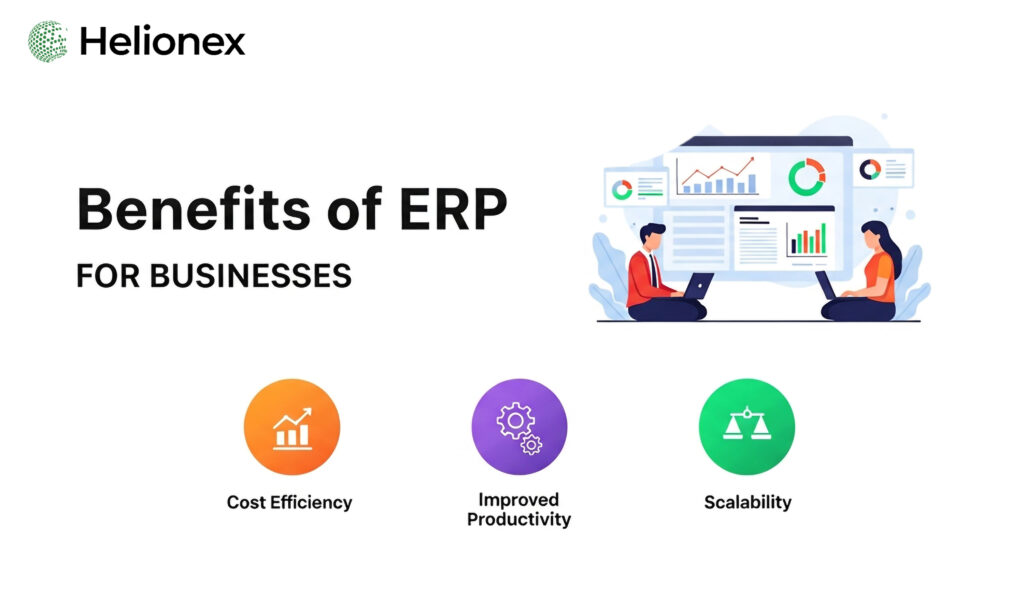
Understanding what is ERP helps businesses see how it revolutionizes daily operations. ERP systems centralize data from finance, HR, supply chain, sales, and CRM, providing a single source of truth that improves collaboration and reduces errors.
Finance teams gain real-time insights for budgeting and reporting, while HR departments automate payroll, performance tracking, and compliance management. Understanding what is ERP shows how supply chain and inventory modules streamline procurement, monitor stock levels, and forecast demand, reducing delays and inefficiencies.
Sales and CRM functions track customer interactions, manage pipelines, and optimize marketing campaigns to enhance revenue and satisfaction. Additionally, modern ERP platforms include AI-powered analytics and business intelligence, enabling predictive insights and faster strategic decision-making.
By connecting all departments, what is ERP helps transform fragmented workflows into a cohesive, efficient system, reduces operational costs, improves productivity, and ensures businesses can scale smoothly while maintaining accuracy, agility, and actionable oversight across the organisation.
Finance & Accounting Automation
- Streamlines invoicing, reconciliations, and payroll
- Provides real-time financial reporting for executives
- Supports compliance and audit readiness
Supply Chain and Inventory Management
- Tracks inventory and orders in real time
- Forecasts demand using AI algorithms
- Improves vendor communication and procurement efficiency
HR & Workforce Management
- Centralizes employee records, payroll, and benefits
- Tracks training, compliance, and performance
- Provides insights for workforce planning
CRM & Customer Insights
- Unified customer database
- Enhances sales, support, and marketing strategies
- Analyzes behavior for predictive marketing
Analytics & Decision-Making
- Real-time dashboards consolidate data across all departments
- Supports KPI measurement and predictive analytics
- Enables faster, informed strategic decisions
Cloud ERP vs On-Premise ERP: Pros and Cons
When evaluating what is ERP for your business, understanding the differences between cloud and on-premise solutions is crucial. Cloud ERP is hosted online, offering scalability, fast deployment, automatic updates, and lower upfront costs.
It enables remote access, AI-powered analytics, and mobile capabilities, making it ideal for growing businesses that value flexibility. On-premise ERP, on the other hand, is installed locally on company servers, offering full control, higher customization, and greater data security for highly regulated industries. However, it requires larger upfront investments, longer implementation timelines, and ongoing internal IT maintenance.
Choosing between the two depends on business size, budget, regulatory requirements, and IT capabilities. Many companies also adopt hybrid ERP, combining cloud flexibility with on-premise control, to balance cost, security, and operational needs while maximizing ROI and efficiency.
By partnering with Helionex for D365 F&O implementation, businesses can align ERP systems with their strategic goals and accelerate return on investment. With structured planning, integration expertise, and phased delivery, this service accelerates ERP adoption and unlocks measurable operational value.
Feature | Cloud ERP | On-Premise ERP |
Cost | Lower upfront, subscription | Higher upfront, hardware cost |
Scalability | Flexible, easily expandable | Limited by internal resources |
Updates | Vendor-managed, automatic | Manual, internal IT team |
Deployment | Fast, ready-to-use | Slower, complex installation |
Customization | Limited | Full customization |
Security | Vendor-managed, often multi-region | Fully controlled internally |
Quote Magnet:
- Cloud ERP: fast deployment, AI-ready, mobile access
- On-Premise ERP: full control, secure, ideal for regulated industries
Common ERP Implementation Mistakes & Best Practices
Understanding what is ERP is only the first step; successful implementation requires careful planning to avoid common pitfalls. Businesses often make mistakes such as skipping workflow mapping, underestimating staff training, ignoring integration challenges, or failing to define clear KPIs. These errors can lead to delayed adoption, inefficiencies, and lower ROI.
To maximize success, organizations should follow best practices: start by mapping existing processes and establishing measurable objectives, involve all stakeholders early, and implement the ERP in phases rather than attempting a full-scale rollout. Strong identity and access controls, such as those provided through Helionex’s Identity Access Management, reduce security risks.
Secure identities across applications help protect sensitive data and support smooth ERP adoption. Providing comprehensive training, testing data migration, and monitoring performance against defined SLAs ensures smooth adoption.
Additionally, leveraging AI analytics, predictive insights, and real-time dashboards helps track progress and optimize operations. By following these best practices, businesses can reduce errors, improve productivity, and achieve the full benefits of ERP while scaling efficiently.
ERP Implementation Checklist:
- Map workflows before ERP selection
- Set measurable KPIs and objectives
- Involve all stakeholders early
- Use a phased rollout approach
- Provide comprehensive staff training
- Test integrations and data migration
- Monitor SLAs and operational metrics
- Ensure compliance and security protocols
What Most Businesses Do Wrong:
- Skip workflow mapping
- Ignore staff training
- Underestimate integration challenges
When This Advice May Not Apply:
- Small businesses with simple processes
- Organizations with very limited IT capacity
Mini Case Example
To understand what is ERP in practice, consider a mid-sized manufacturing company struggling with delayed reporting and inventory errors. Before ERP, finance, HR, and supply chain teams worked in silos, leading to inefficiencies and miscommunication.
After implementing a cloud-based ERP system, the company integrated finance, procurement, production, and sales into a single platform. Real-time dashboards improved decision-making, automated workflows reduced manual errors, and inventory tracking became precise.
A mid-sized manufacturing company struggled with reporting delays and inventory mismanagement. Implementing Helionex’s cloud ERP integrated finance, procurement, production, and sales, reducing errors by 35% and accelerating production planning by 20%.
Why Choose Helionex as Your ERP Partner
When exploring what is ERP, choosing the right implementation partner is critical for achieving success and maximizing ROI. Helionex stands out by offering expert guidance, leveraging decades of ERP implementation experience to ensure smooth adoption.
Our customized solutions provide fully customizable ERP modules designed for diverse industries, from manufacturing and healthcare to finance and retail. We deliver end-to-end support, guiding businesses from system selection to deployment, staff training, and ongoing maintenance. Data security and compliance are a top priority, with GDPR, ISO 27001, and local regulations fully incorporated into our processes.
Through proven ROI, Helionex has helped companies streamline workflows, reduce operational costs, and improve decision-making, as documented in multiple real-world case studies. Partnering with Helionex ensures that ERP implementation is strategic, efficient, and aligned with your business growth objectives. Effective ERP adoption relies on the right team in place Helionex’s Workforce Scaling & Management ensures scalable support and expertise throughout your ERP journey.
Conclusion
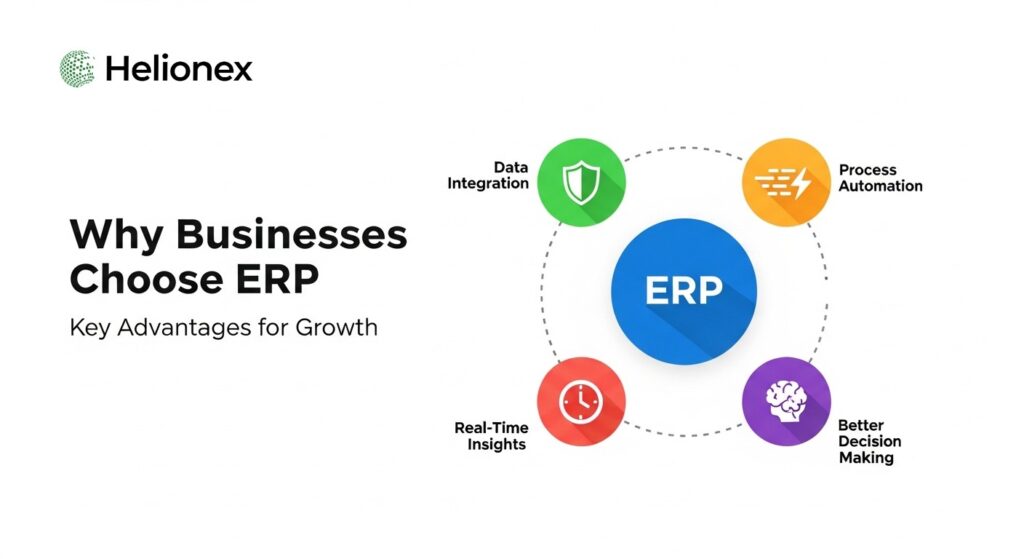
Understanding what is ERP and its transformative potential is essential for any modern business seeking efficiency, scalability, and strategic growth. ERP centralizes core operations, automates workflows, and provides real-time insights across finance, HR, supply chain, and CRM, enabling data-driven decisions that directly improve ROI.
Successful adoption requires careful planning, stakeholder involvement, clear SOPs, and vendor expertise to avoid common implementation pitfalls. By partnering with Helionex, businesses gain customized ERP solutions, expert guidance, and end-to-end support, ensuring secure, efficient, and scalable deployment.
With Helionex, companies can fully leverage ERP to streamline operations, enhance collaboration, optimize resources, and achieve measurable business outcomes, making ERP adoption a strategic advantage rather than just a software upgrade.
FAQs
1. How does ERP transform supply chain management?
ERP centralizes supply chain data, tracks inventory, automates procurement, and improves supplier coordination, reducing delays and optimizing costs.
2. What are the different ERP modules and their functions?
ERP modules include Finance, HR, Inventory & Procurement, Sales & CRM, and Analytics & BI, each automating workflows and centralizing data across departments.
3. Signs your business needs ERP software
ERP is needed when reporting is slow, departments operate in silos, manual processes are repetitive, inventory errors occur, or scaling is difficult.
4. ERP trends for 2026: cloud, AI, and mobile adoption
Modern ERP trends include cloud deployment, AI analytics, and mobile access, enabling scalability, efficiency, and real-time decision-making.
5. How ERP reduces errors and improves collaboration
ERP centralises data, eliminates redundant processes, and provides a single source of truth, enhancing accuracy and cross-department collaboration.