
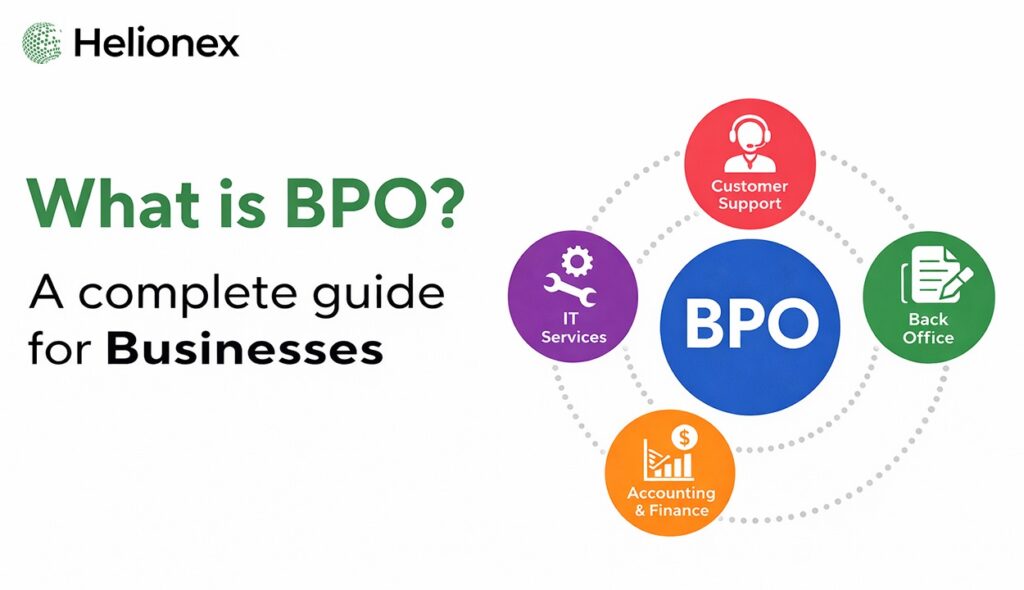
BPO is defined as engaging an outside vendor for the operation of a standard business process such as customer care, payroll processing, HR admin, finance and accounting functions, or technical support at mutually agreed service levels.
If you’ve ever been asked ‘What is BPO?’ the short answer is that BPO is contracting a repeatable business process to an external specialist provider to acquire a capacity for specialized expertise, the need for efficiencies or even to add a variable component to their cost structures and team sizes without necessarily being focused on simply lowering the bottom line costs.
If BPO continues to appear on your company’s horizon and you desire a direct answer on what it means to your business, here it is. Best described, BPO is not just “outsourcing jobs”. When done strategically, it’s essentially allowing your most valuable team members the bandwidth to concentrate on the activities that drive business and progress. What processes your company considers outsourcing could be customer service.
Perhaps for your organization it could be processing of invoices and payroll. It can include administrative duties, data input, IT support or processing insurance claims.
What is BPO?
BPO stands for business process outsourcing. It’s when you hire an external provider to perform a function in your business rather than having to build, operate, and manage that function internally.
The BPO definitions that appear on our current ranking pages are quite consistent: it’s when an enterprise partners with a third party that’s responsible for executing specific non-critical or labor-intensive tasks. BPO is the outsourcing of processes.
It’s not a “fire-and-forget” type of project. It’s a dedicated, repeat operation with defined inputs, outputs, SLAs, reporting, and escalation processes, outsourced to a partner, rather than handled by a consultant who advises on strategy or a freelancer who completes a one-off task.
Once you see that distinction, your outsourcing decisions will be much better.
How Helionex Can Help Your Business
As businesses adopt Business Process Outsourcing (BPO) to improve efficiency and reduce operational costs, having the right technology and outsourcing partner becomes equally important. At Helionex, we provide end-to-end BPO and ERP implementation services that help organizations streamline operations, automate workflows, and scale with confidence. Explore our services below to see how we can support your digital transformation journey.
How does BPO work in practice?
The structure and stages are critical for ensuring efficiency, accountability, and measurable return on investment for a successful BPO deal. Selecting the right repeatable tasks to outsource, standardizing and documenting the workflow, selecting a vendor that can deliver, and monitoring performance all go towards ensuring business processes become more efficient, mistakes less frequent, and costs lower.
However, before those benefits can be fully realized, it’s important to consider the answer to this question: what is BPO?
A healthy BPO relationship typically follows a logical pattern:
- You select a business process that is valuable but which you do not need to completely control in-house.
- You define the process in its current form.
- You find a vendor with demonstrated experience, systems, and processes in place to deliver your workflow.
- You negotiate scope, performance targets, service levels, escalation points, and reporting.
- You manage the work’s transition over a series of phases.
- You monitor the results and continuously work on process improvements.
That sequence matches many of the descriptions of the outsourcing lifecycle you’ll find in current ranking guides-in fact, especially in their more operational sections.
What a BPO partner usually owns
With the BPO partner providing service for this activity, they are responsible for the end-to-end process execution including staffing, training, queue management, SLA adherence, reporting, quality control, workforce planning etc. With the BPO provider taking up the responsibility, your business has the freedom to concentrate on the strategic functions, knowing that the outsourced activity is being executed with the desired quality.
What a BPO partner can take over:
- Staffing of the outsourced activity
- Training delivery
- Daily operations execution
- SLA reporting
- Queue management
- Workforce scheduling
- SOP adherence
- Quality assurance operations
What you as a business still need to own
When engaging a BPO partner for your process, ultimate responsibility remains with your company.
If you wonder “what is bpo”, a key element is to be clear on where delegation takes place and where ownership needs to stay.
This means that even with outsourced processes, you are still the owner of the customer promise, the design standards of the processes, vendor governance, all approvals and exceptions and brand sensitive judgment calls. You must also continue to have accountability.
“You still own the outcome” is probably one of the most often missed areas among outsourcing buyers. So, as per what is bpo, we advise you to let a BPO vendor manage the day-to-day execution but they are not here to take away your product leadership, overall strategic accountability or your decision-making ability in case of escalations or tough calls that require brand context.
What types of BPO services can businesses outsource?
Businesses have a vast list of process-specific and geographically dispersed functions they could outsource. In simplest terms, “what is BPO?” It’s both front-office and back-office functions customized to suit business requirements. Commonly found front-office functions for BPO range from customer service calls to technical support, customer sales support, and even scheduling customer appointments.
Common back-office functions for BPO consist of internal services like accounting, human resources administrative tasks, accounts payable, payroll administration, and it help desk services. Additionally, organizations can opt for offshore, nearshore, or onshore solutions that can best support the particular company by enabling a business to leverage efficient operating models, meet client expectations, and offer flexibility.
BPO could also be understood by viewing the processes in terms of these two viewpoints:
- The type of functions and responsibilities
- The geographic location of the provider
Odoo ERP Implementation Services
Managing outsourced business processes becomes much easier with an integrated ERP system. Helionex’s Odoo ERP implementation services help businesses automate HR, finance, inventory, customer service, and operations through one centralized platform, improving efficiency and visibility.
Front-office vs back-office BPO
Top pages almost universally segment BPO into front office and back office processes.
Front office BPO involves tasks that are client facing:
- Customer Service Support
- Technical Support
- Sales Support
- Appointment Setting
- Lead Qualification
- Chat/Email/Telephone
Support Back office BPO processes are more about supporting business functions internally:
- Payroll Processing
- HR administration
- Bookkeeping and Accounting
- Invoicing
- Claims management
- Data entry
- Compliance writing
- IT Support
Learn how companies can engage with the future generation of customers through personalised, omnichannel solutions. Insights into how you can increase satisfaction, build loyalty and retain more customers through engaging solutions.
Onshore, Nearshore, Offshore BPO
Perhaps another helpful way of distinguishing between different types of BPO is to segment by provider location: onshore, near shore, or offshore. For those trying to answer the question “What is BPO?” (which is outsourced business functions), it’s useful to know about location segments because it’s used often across ranking pages, readily quotable, and tightly related to the buyers’ search intent.
Model | Best for | Main advantage | Main trade-off | Typical watch-out |
Onshore BPO | regulated work, brand-sensitive support, high-context work | easier language, culture, compliance, and collaboration | highest cost | assuming “same country” automatically means better operations |
Nearshore BPO | teams that want time-zone overlap and moderate savings | balance between cost and collaboration | talent pool may be narrower by function | underestimating process and training needs |
Offshore BPO | high-volume repeatable work and 24/7 coverage | largest cost advantage and broad talent access | more handoff complexity | weak SOPs, QA drift, and communication gaps |
Key takeaway:
What it comes down to in determining the right location model is less Geography and more about the judgement and nuance required with the customer, as well as the compliance risk and pressure involved with the business process.
Common BPO Examples by Department
Here’s what BPO often looks like in real businesses
- Customer support: Chat, email, phone, order tracking, Tier 1 troubleshooting
- Finance: Billing, accounts payable, invoice processing, assistance with reconciliation
- HR: Payroll administration, benefits admin, coordination of onboarding
- IT: Help desk, password reset, device setup, user support
- Operations: Data entry, order processing, documentation, scheduling
- Sales support: Lead qualification, CRM cleaning, outbound follow-up
Learn how Microsoft Dynamics 365 can automate and simplify financial processes, from invoicing to reporting. Streamline operations, reduce errors, and achieve greater efficiency and cost control in financial management.
Microsoft Dynamics 365 Finance & Operations Implementation
As outsourced operations grow, businesses need greater control over finance, supply chain, procurement, and compliance. Helionex’s Microsoft Dynamics 365 Finance & Operations Implementation enables organizations to manage enterprise-wide operations with real-time insights and intelligent automation.
Why Do Businesses Use BPO?
For businesses looking to scale up quickly, utilize industry-specific expertise, and reduce operational costs without overburdening employees, BPO is one of the most common paths. Utilize industry-specific expertise and bring down operational costs without overburdening the employees, BPO services are one of the many options.
BPO means outsourcing tasks that can be easily repeated, process-based (customer support, payroll, data entry, etc.), for which organizations may not have resources, or they might be too small and don’t want to employ for every single function. This can enable businesses to concentrate on strategic activities, ensure quality, improve processes and ensure a predictable return on investment, extend working hours to 24/7.
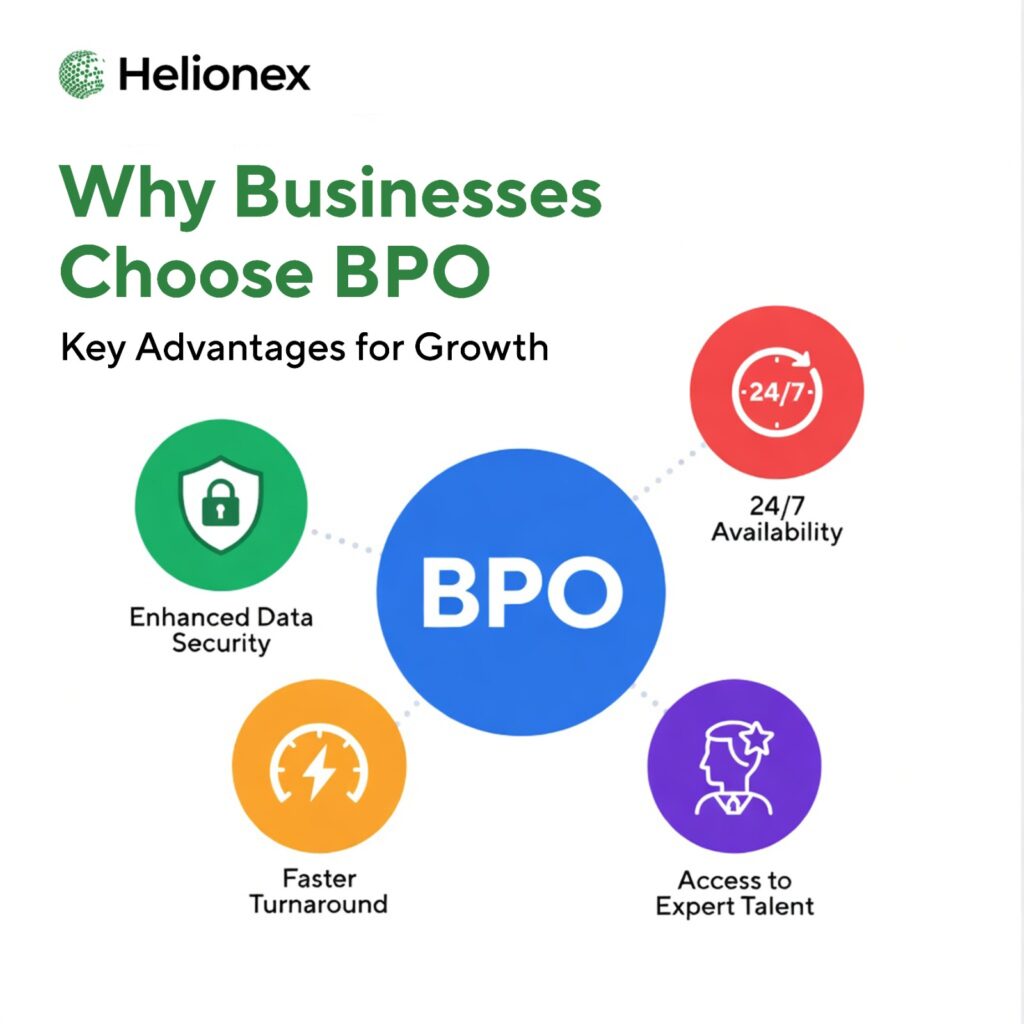
Businesses usually choose BPO for one or more of these reasons:
- They need to scale faster than they can hire
- They want specialist expertise
- They want more predictable operating costs
- They need extended hours or 24/7 coverage
- They want internal teams focused on higher-value work
- They need a process to become more consistent
Those benefits are consistent across today’s leading pages, though many still over-emphasize “cost savings” and under-explain operational leverage. Discover how Marketing Mix Modeling (MMM) helps businesses measure the effectiveness of campaigns and optimize marketing spend. Learn strategies to drive better ROI through data-driven insights and informed decision-making.
- Best for: Small teams whose founders or managers are buried in repetitive operational tasks.
- Why it works: BPO can scale staff around key operations without the full internal build that may be needed for a temporary surge, or while your team focuses on core growth functions.
What are the Risks of BPO?
BPO is helpful, but it’s not magical. The key risks that come up in the SERP and customer interactions alike when looking at what is BPO are easy to spot: data security, hidden costs, communication breaks, overreliance on your partner, and lack of control over quality and context between your company and your team.
Discussions on the topic of outsourced support also hint at a specific fear that a standard SEO guide might overlook: some executives express concerns they will lose connection with customers, and thus opportunities to collect product insights that ought to remain at the core of their business.
Pros and cons at a glance
Pros
- Faster scaling ability
- Greater staff flexibility
- Access to specialist process
- Lower fixed cost
- Increased coverage
- Better process discipline when managed well
Cons
- Poor internal context with poor onboarding
- Potential variability in quality on ramp
- Security & compliance exposure if controls are insufficient
- Undiscovered transition cost
- Vendor dependency
- Brand risk if customer-facing interaction feels off-script/ robotic
What most people do wrong?
Most companies don’t fail at BPO because outsourcing is a bad idea. They fail because they offshore too soon, too vaguely, or too cheaply.
Common blunders include:
- Outsourcing broken processes rather than fixing them
- Choosing a low rate over a robust operating model
- Neglecting to document processes (SOPs)
- Using non-specific SLAs that fail to set concrete outcomes
- Lacking single points of responsibility in-house
- Outsourcing exception-dense processes too early
- Viewing onboarding as a week-long handover rather than building the operating system
These are all directly from community feedback around challenges such as SLA management, service expansion, and support outsourcing.
When should you outsource and when should you keep it in-house?
Organizations should offshore activities that are repeatable, high-volume, and process-driven, and that can be well-documented with SOPs, quality metrics and monitoring. These could be customer service, payroll, data entry, invoice processing, and other processes of this nature.
If you’re asking “what is BPO”, then it’s the outsourcing of these tasks and retaining in-house tasks that are strategic, exception-heavy, or focused on innovation — such as product strategy, executive relationship management, early-stage sales conversations, or complex, highly regulated workflows.
A good rule is this:
Outsource repeatable work. Keep judgment-heavy work close until the system is mature.
Good candidates for BPO
The following process elements usually support a good fit for BPO:
- Repeatable
- Documented
- Measurable
- Not heavily dependent on product strategy
- High volume
- Trainable
- SOP/quality scoring compliant.
Work you should usually keep in-house first
You’ll probably want to bring these in house first:
- Product strategy work
- Complaint resolution edge cases
- Strictly-regulated exception handling
- Executive relationship management
- Early stage sales conversations involving significant product detail
- Workflows that change weekly
When this advice may not apply
There are however exceptions.
In environments with a very strong existing process documentation, internal QA and an established governance you may want to BPO certain more sophisticated processes earlier. Conversely, if you are in a highly regulated sector and your brand relies heavily on consultative conversations, it may not be the process itself that’s complex but the customer interactions may be better suited to keep tighter control over due to certifications, regulatory concerns or brand perception.
Due diligence is becoming more formalized in procurement-heavy organization due to the necessity to manage multiple relationships, hence the importance of evidence and standards (e.g., SOC reporting, information security management, supplier due diligence) over abstract promises.
How do you choose the right BPO partner?
This is where the rubber hits the road and where you win or lose most buying decisions. The real question isn’t ‘Can you do that?’ It’s, ‘Can you do that in a manner that preserves our customer experience, customer data, reporting, and escalation paths?’
The vendor selection checklist
At first, you need to gather information about what is BPO, and then use this before signing any BPO agreement:
- The domain is well understood.
- The process either has existing, documented SOPs, or can be documented rapidly.
- There are defined measures for success.
- Service Level Agreements are established for speed, and quality.
- Escalation procedures have been documented.
- A frequency has been agreed upon for reporting.
- There is clearly assigned ownership of Quality Assurance processes.
- Security controls are established.
- Permissions are on a least-privilege basis.
- There is a defined, meaningful timeline for knowledge transfer.
- There is a documented disaster recovery / business continuity plan.
- There is a single internal contact point and leader for the engagement.
Questions to ask before signing
Ask a provider:
- What equivalent processes have you performed in the past?
- What is your onboarding process/ramp time?
- How do you qualify the quality of the output?
- How do you deal with exceptions?
- What tools do you use?
- How do we perform performance reviews?
- What’s your plan for increased volumes?
- How do you deal with attrition?
- How do you secure customer data?
- What’s your business continuity process?
Security, compliance, and SLA checks
If the provider is going to handle customer data, payment data, employee data, or regulated workflows, then when answering what is BPO, do not just rely on sales deck assurances.
Ask for:
- Documentation about the security controls
- Audit readiness
- Formal access control procedures
- Practices and policies for responding to security incidents
- Records of due diligence
- Appropriate assurance such as SOC reporting
- Use of industry best-practice information security principles
This is not an unreasonable expectation for sophisticated outsourcers. This aligns with widely recognized standards; NIST guidance on supplier due diligence, AICPA’s SOC 2 framework for security and trust criteria, and ISO/IEC 27001.
What Does a Successful BPO Rollout Look Like?
Top Performing BPO transitions Are Done In Phases, not overnight Smooth transitions happen in stages and not abruptly The best BPO transitions don’t happen overnight. Both your company and the outsourcing provider need to acclimatize and build comfort over a given period. Implementing a small pilot or an initial limited scope of work helps iron out operational kinks, improve SOPs and stabilize workflows before undertaking the full project scope.
The incremental progress at each stage with regular monitoring and quality analysis allows for greater consistency and error reduction, while proving clear and measurable ROI.
Phased transitions enable you to maintain control and accountability to your overall business objectives, giving the process predictability and a higher chance of success.
It is to delegate business functions to third parties with which one will keep the control of their core operations. The best BPO transitions are phased, not rushed.
A simple 90-day rollout plan
Days 1-30:
- Discovery and documentation
- Map the process
- Identify exceptions
- Create SOPs
- Define KPIs and SLAs
- Confirm tools and access
Days 31-60:
- Training and controlled launch
- Train the vendor team
- Start with a narrow scope
- Review quality daily or weekly
- Fix documentation gaps quickly
Days 61-90: Stabilise and expand
- Widen the scope
- Move from training mode to steady-state reporting
- Monitor quality, speed and escalations
- Decide what to keep in-house vs hand off next
Mini case example
Illustrative example:
A rapidly expanding e-commerce company had an internal team of 3 answering customer email, chat, questions about refunds and order status. The company was slow to respond, and founders were fielding simple tickets themselves in the evenings.
Rather than outsourcing all support in one big chunk, the founders outsourced only Tier 1 (order tracking, shipping questions, password reset, policy questions, returns) and kept Tier 2 and above in-house. This meant escalation handling, complaints/retrieval and VIP clients were all internal.
The outcome was not an “instant savings” play; the initial reward was space. Since they had worked out all macros, edge cases, and the exact rules on refunds beforehand, the quality stayed high, while their internal team started to handle product related questions and customer retention more than simple support issues and unusual cases.
This is what successful BPO often looks like: not replacement but gradual hand over.
Final takeaways for businesses considering BPO
BPO is not a shortcut. It’s a scaling solution. If your business has a repeatable process, a predictable outcome, and the actual demand for the capacity or the niche expertise, and you’re wondering what BPO is, then it can be a really great option. But if the process is still a bit messy, if it hasn’t been well-documented or if it’s really reliant on some sort of tribal knowledge, then trying to out-source it too early can be more complicated than beneficial.
The best way is to:
Document it first. Outsource it in stages
Clearly maintain ownership
Pay for quality, not time
The partner that offers the best operational match (not just the cheapest price). Do that and BPO will start meaning so much more than just outsourcing, building a stronger, better focused business.
FAQ
What does BPO mean in business?
BPO is short for business process outsourcing, it is hiring a third-party vendor for the regular business functions, such as customer service, payroll, HR administrative tasks, and accounting, HR and IT help desk support
What is an example of BPO?
An example often used for this: A company outsources chat support, customer service via email and other methods to a third party with specific skills and tools for this rather than building its own in-house team of support agents.
Is BPO the same as outsourcing?
BPO falls under the umbrella of outsourcing but it is more targeted. Typically refers to the delegating of a whole structured business process rather than just sub-contracting single isolated tasks to an outside entity.
What are the main types of BPO?
The main types are front-office and back-office BPO. Businesses also describe BPO by location model: onshore, nearshore, and offshore.
Why do companies use BPO?
Businesses opt for BPO in an effort to enhance operational efficiency, access expertise they lack in-house, rapidly scale their operations, offer support 24/7, and relieve in-house teams to focus on higher-value activities – this list explains ‘what is BPO in the modern era’ for all.