Running a business today is not just about growth, it’s about managing complexity. As companies expand, they often reach a point where internal teams alone cannot handle everything efficiently. Whether it’s technology development, IT operations, customer support, or specialized engineering work, the workload eventually becomes too heavy to manage in-house.That’s usually when outsourcing becomes a …

Running a business today is not just about growth, it’s about managing complexity. As companies expand, they often reach a point where internal teams alone cannot handle everything efficiently. Whether it’s technology development, IT operations, customer support, or specialized engineering work, the workload eventually becomes too heavy to manage in-house.
That’s usually when outsourcing becomes a serious consideration.
But here’s the real challenge: outsourcing itself is not the solution. The real success depends on choosing the right outsourcing partner.
A good outsourcing partner quietly becomes an extension of your team. They understand your goals, adapt to your workflow, and help you scale without friction. A poor one, on the other hand, creates delays, confusion, hidden costs, and unnecessary stress that slows your business down instead of accelerating it.
This is why learning how to choose the right outsourcing partner is not just a business skill—it’s a strategic decision that directly impacts your growth.
What Is an Outsourcing Partner?
An outsourcing partner is more than just a service provider. It is a third-party organization that takes responsibility for specific parts of your business operations so you can focus on your core strengths.
These services can include software development, ERP implementation, IT infrastructure management, cybersecurity, cloud operations, customer service, and more.
But the best outsourcing partners don’t just “complete tasks.” They bring structure, expertise, and long-term thinking into your operations. They help you build systems that are not only functional today but scalable for tomorrow.
In simple terms, a strong outsourcing partner becomes a strategic extension of your business—not just a vendor.
Why Businesses Choose Outsourcing
Most companies don’t outsource just to save money. They outsource because growth brings complexity.
As operations scale, internal teams often struggle to keep up with increasing demands. Hiring takes time, training is expensive, and maintaining specialized expertise in every area is unrealistic.
Outsourcing solves this gap by providing immediate access to skilled professionals who already understand the domain.
It also helps businesses move faster. Instead of building everything from scratch, companies can plug into existing expertise and accelerate execution. This is especially valuable in industries where speed defines competitiveness.
More importantly, outsourcing allows internal teams to focus on what truly matters—strategy, innovation, and customer growth.
Business Process Outsourcing plays a major role in helping organizations reduce operational burden and improve efficiency by delegating non-core functions to specialized teams. It allows companies to focus more on growth while improving process quality and execution speed.
Offshore vs Nearshore vs Onshore Outsourcing
Model | Cost Level | Communication Ease | Speed | Best Use Case |
Offshore | Low | Moderate to Low | High (depending on team) | Cost-sensitive projects |
Nearshore | Medium | High | High | Balanced collaboration |
Onshore | High | Very High | Very High | High-security or critical systems |
How to Choose the Right Outsourcing Partner
Look Beyond Experience—Look for Understanding
Experience matters, but understanding matters more.
A strong outsourcing partner doesn’t just know your industry—they understand your challenges. They recognize where businesses typically struggle, what slows down execution, and how to solve problems before they become risks.
When evaluating partners, look at their past work, but also pay attention to how they talk about your requirements. The right partner will ask deeper questions, not just offer quick solutions.
Communication Is Everything
Many outsourcing relationships fail not because of technical issues, but because of communication gaps.
If communication is unclear at the beginning, it becomes even more complicated once the project starts.
A reliable outsourcing partner keeps communication simple, transparent, and consistent. They don’t leave you guessing. Instead, they provide updates, clarify expectations, and make sure everyone stays aligned.
You should always feel like you know what is happening in your project—not discover problems when it’s too late.
Technical Strength Should Be Proven, Not Claimed
Every outsourcing company claims to be “expert.” But real expertise shows up in execution.
You should look at how they build systems, how they design architecture, and how they handle complexity. If possible, ask them to walk you through real examples of past projects.
A strong technical partner will always be able to explain not just what they built—but why they built it that way.
That difference matters more than most businesses realise.
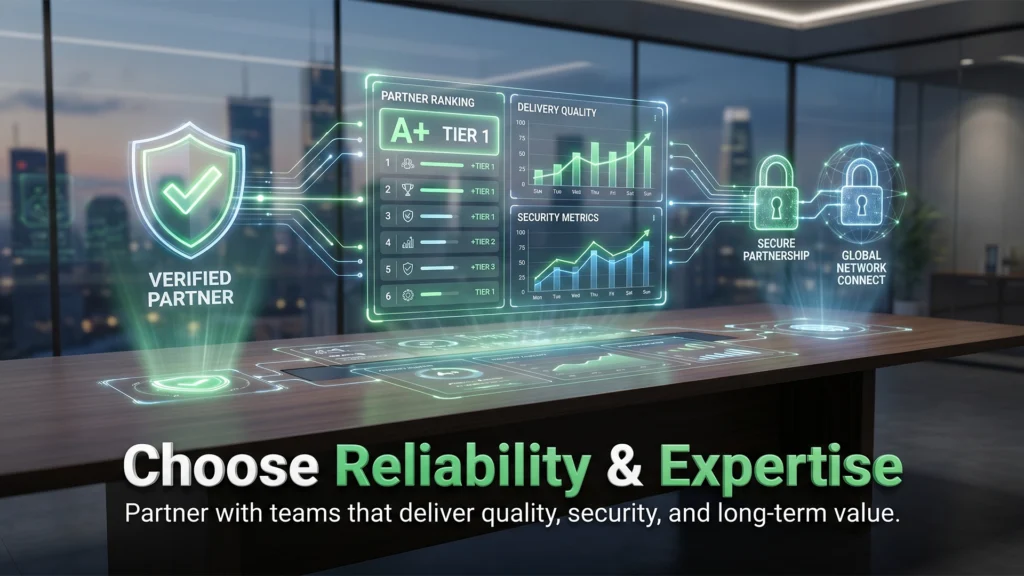
Understand How They Deliver Work
Not all outsourcing models are the same, and choosing the wrong one can create long-term friction.
Some businesses need dedicated teams that act like internal employees. Others need project-based delivery for fixed outcomes. Some require ongoing managed services for continuous operations.
The key is alignment. The delivery model should fit your business not force your business to adapt to it.
Think About Scalability Early
Many businesses focus only on immediate needs when choosing an outsourcing partner. But real growth requires thinking ahead.
Your partner should be able to scale with you not limit you.
As your workload increases, they should be able to expand resources, adjust processes, and support new requirements without disruption.
If scaling feels difficult at the beginning, it will only become harder later.
Workforce scalability is one of the most critical factors in outsourcing success. Businesses need the ability to quickly expand or adjust their teams based on project demand, workload fluctuations, and long-term growth plans without operational disruption.
Security Is Not Optional
When you outsource, you are often sharing sensitive data, internal systems, and operational processes.
This makes security one of the most important factors in your decision.
A reliable partner will always take security seriously. They will have clear policies, compliance standards, access controls, and backup systems in place.
If security feels like an afterthought, that is a serious red flag.
Reputation Tells You What Sales Never Will
Every company looks good in a proposal. But real reputation comes from client experience.
Look at long-term clients, repeat projects, and honest feedback. These are far better indicators than marketing claims.
If a company consistently retains clients, it usually means they deliver value beyond expectations.
Pricing Should Make Sense, Not Just Look Cheap
Low pricing is often attractive—but it can also be misleading.
Cheap outsourcing usually comes with hidden costs like rework, delays, and poor quality output.
Instead of focusing on the lowest price, focus on long-term value. A slightly higher investment in the right partner often saves significantly more in operational costs later.
Process Matters More Than Promises
A good outsourcing partner doesn’t rely on promises—they rely on systems.
Clear workflows, structured project management, milestone tracking, and reporting systems are signs of maturity.
Without these, even skilled teams can become unpredictable. You can also get some ideas from the insights forums to know more.
A Real Partner Thinks Long-Term
The best outsourcing relationships are not transactional. They evolve into partnerships.
A true partner understands your business goals, adapts to your changes, and actively contributes to your growth.
They don’t just deliver tasks they help you improve how your business operates.
Common Mistakes Businesses Make
Many companies make outsourcing decisions too quickly. Some choose based only on price. Others skip technical evaluation or ignore communication style.
These mistakes often lead to frustration later because the foundation of the partnership was never properly evaluated.
Outsourcing works best when decisions are thoughtful, structured, and based on long-term thinking.
Red Flags You Should Never Ignore
If a vendor avoids technical questions, gives unclear timelines, or struggles to explain their process, that’s a warning sign.
Similarly, inconsistent communication or unrealistic pricing promises usually indicate future delivery issues.
Trust your evaluation process if something feels unclear early, it rarely improves later.
Key Questions to Ask Before Hiring an Outsourcing Partner
Category | Questions to Ask | Why It Matters |
Experience | What industries have you worked in? | Ensures domain relevance |
Communication | How often will updates be shared? | Avoids misalignment |
Security | What security standards do you follow? | Protects sensitive data |
Scalability | Can you scale resources quickly? | Supports business growth |
Delivery | What project management method do you use? | Ensures structured execution |
Flexibility | How do you handle scope changes? | Prevents project disruption |
Support | What post-project support do you offer? | Ensures long-term stability |
Why Choosing the Right Outsourcing Partner Matters
The impact of this decision goes far beyond a single project.
The right outsourcing partner can help your business move faster, operate more efficiently, and scale without friction. The wrong one can slow everything down and create unnecessary operational burden.
This is why understanding how to choose the right outsourcing partner is not just about outsourcing it’s about protecting your business growth.
Why Choose Helionex as Your Outsourcing Partner
At Helionex, we believe outsourcing should feel like collaboration, not delegation.
We don’t just deliver services, we work as an extension of your team. Our focus is on building systems that support long-term growth, not just short-term execution.
We help businesses streamline operations, improve workflows, scale technical teams, and reduce operational risks through structured and transparent delivery models.
What makes us different is simple—we care about how your business performs after delivery, not just during it.

Conclusion
Choosing the right outsourcing partner is ultimately about trust, clarity, and long-term alignment.
It’s not just about who can do the work—but who can do it in a way that supports your growth, adapts to your challenges, and scales with your future.
When you approach outsourcing with the right evaluation mindset, you don’t just reduce risk—you unlock a powerful growth engine for your business.
And that is exactly what makes learning how to choose the right outsourcing partner so important in today’s business environment.
FAQ’s
How do I choose the right outsourcing partner?
Look at experience, communication quality, technical capability, scalability, and long-term reliability—not just pricing.
What is the biggest outsourcing risk?
Poor communication and lack of clear expectations are the most common causes of failure.
Should I start with a trial project?
Yes, a small pilot project is one of the best ways to evaluate real performance.
Is outsourcing only for cost saving?
No, it is mainly about accessing expertise and scaling faster.
What makes a good outsourcing partner?
A mix of technical skill, communication clarity, structured processes, and long-term mindset.
Why choose Helionex?
We focus on scalable, transparent, and performance-driven outsourcing partnerships built for long-term success.