Retail businesses today operate in a highly competitive and rapidly evolving environment. Consumer expectations are changing, omnichannel shopping is becoming the norm, and operational complexity increases with every new store, product line, supplier, and sales channel. While growth is the ultimate goal for most retail chains, scaling successfully requires more than simply expanding locations or …
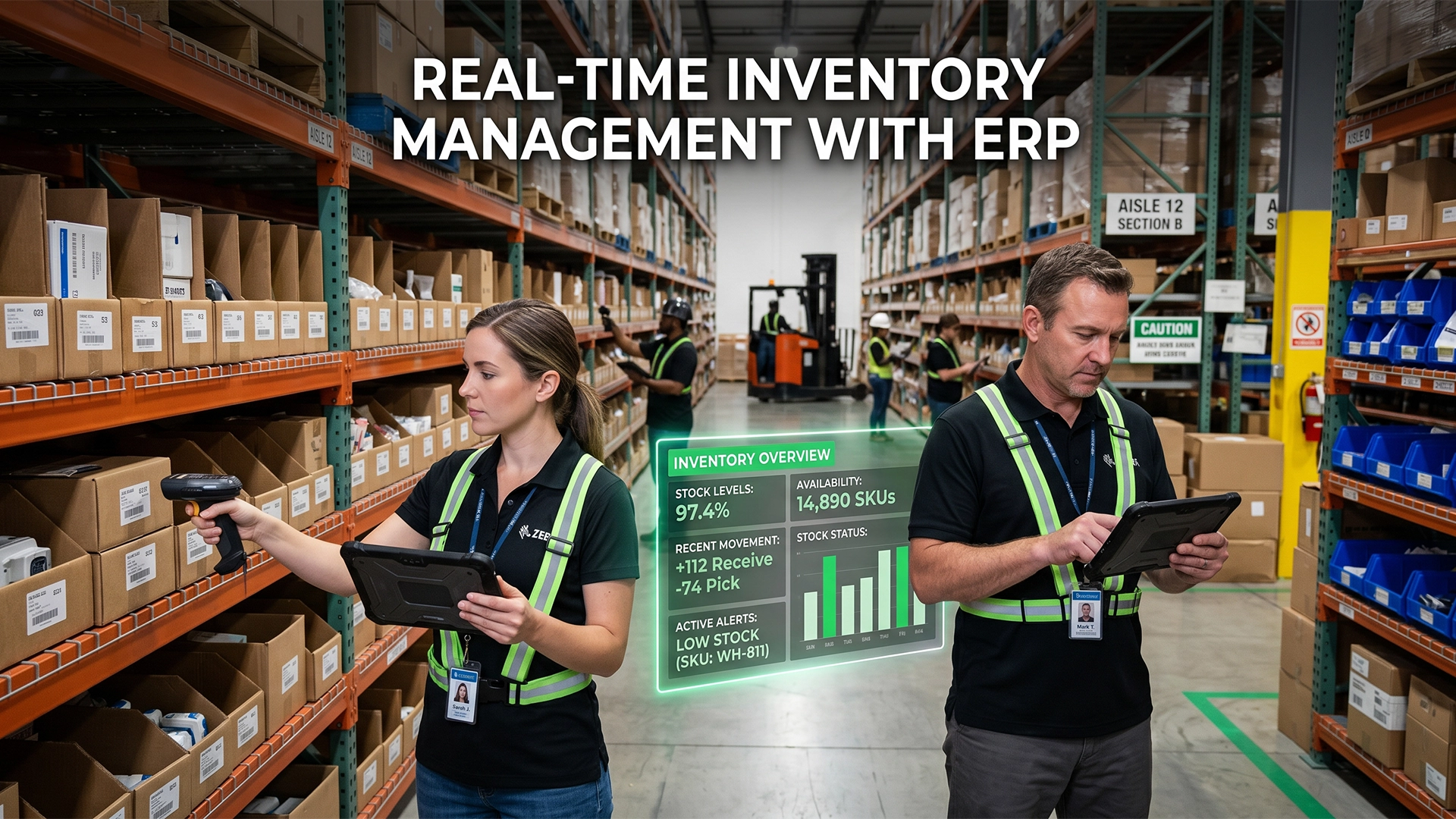
Many retailers discover that the systems and processes that supported them during their early growth stages become barriers as the business expands. Managing inventory across multiple locations, coordinating supply chains, maintaining accurate financial records, and delivering consistent customer experiences can quickly become overwhelming without the right technology.
This is where understanding how ERP helps retail chains scale operations becomes essential.
Enterprise Resource Planning (ERP) systems provide a centralized platform that connects critical business functions, allowing retail chains to streamline operations, improve visibility, automate workflows, and support sustainable growth. Rather than managing separate systems for inventory, purchasing, finance, warehousing, and sales, retailers can bring everything together under one integrated solution.
In this guide, we’ll explore how ERP helps retail chains scale operations, the challenges it solves, the benefits it delivers, and why ERP has become one of the most important investments for growing retail organizations.
Retail Scaling Challenges and How ERP Helps Retail Chains Scale Operations Efficiently
As retail chains expand, they often face:
- Inventory inaccuracies across multiple locations
- Inconsistent reporting between departments
- Manual data entry and duplicated work
- Supply chain inefficiencies
- Delayed decision-making
- Poor visibility into business performance
- Difficulty forecasting demand
- Increasing administrative costs
- Challenges managing omnichannel operations
Without a centralized system, these issues become more difficult to manage as the organization grows.
For many retailers, growth doesn’t fail because of a lack of demand. It fails because operational systems cannot keep pace with expansion.
What Is ERP and Why Does It Matter in Retail?
Enterprise Resource Planning (ERP) is a business management software system that integrates multiple departments and processes into one centralized platform.
For retailers, ERP typically connects:
- Inventory management
- Point-of-sale (POS) systems
- Procurement and purchasing
- Supply chain management
- Warehouse operations
- Accounting and finance
- Customer data
- Reporting and analytics
- Human resources
- Ecommerce platforms
Instead of using disconnected software applications, ERP creates a single source of truth where all departments access the same real-time information.
This level of integration is one of the primary reasons how ERP helps retail chains scale operations has become such an important topic for modern retailers.
Many growing retail chains choose Odoo ERP for its flexibility, modular design, and cost-effective scalability. Our Odoo ERP Implementation helps businesses unify operations like inventory, sales, finance, and procurement under one centralized system.
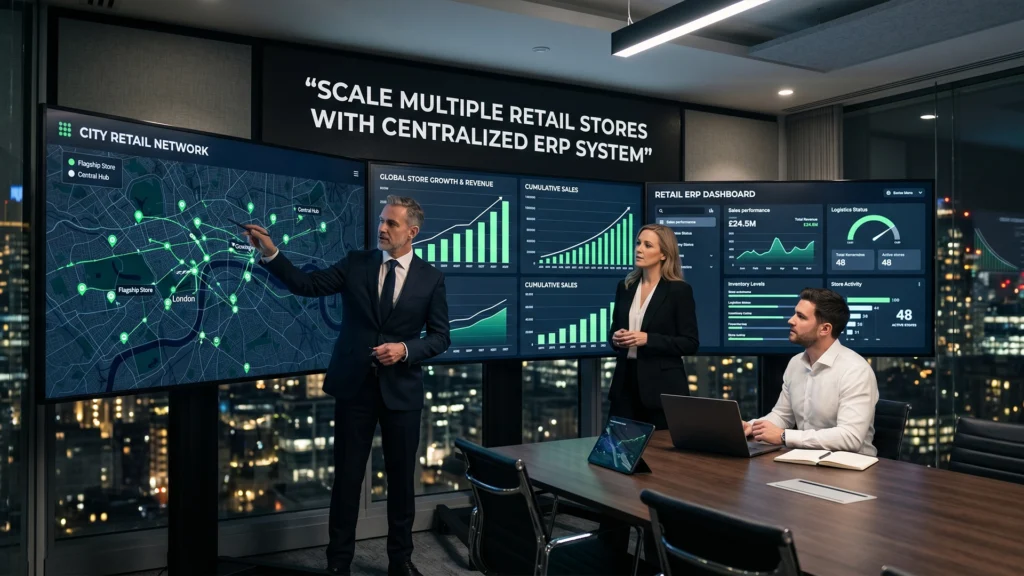
Why Retail Chains Outgrow Traditional Systems
Many retail businesses begin with basic tools such as spreadsheets, standalone accounting software, and separate inventory management systems.
While these solutions may work initially, they often create significant challenges during expansion.
Data Silos
Different departments maintain their own records, resulting in conflicting information and reporting discrepancies.
Manual Processes
Employees spend excessive time updating spreadsheets, transferring data between systems, and correcting errors.
Limited Visibility
Leadership teams struggle to obtain accurate, real-time insights into inventory, sales, and financial performance.
Scalability Constraints
Legacy systems often lack the flexibility required to support new locations, products, and sales channels.
ERP addresses these issues by creating a unified operational framework that grows alongside the business.
How ERP Helps Retail Chains Scale Operations
Understanding how ERP helps retail chains scale operations requires examining the key capabilities that enable retailers to manage growth more effectively.
- Centralized Inventory Management
Inventory is one of the most valuable assets for any retail organization.
Without accurate inventory visibility, retailers risk:
- Stockouts
- Overstocking
- Lost sales
- Excess inventory carrying costs
- Reduced customer satisfaction
ERP systems provide real-time inventory tracking across:
- Retail stores
- Distribution centers
- Warehouses
- Ecommerce channels
Benefits of Centralized Inventory Management
- Improved stock accuracy
- Better inventory planning
- Faster replenishment
- Reduced inventory waste
- Greater product availability
- Improved Multi-Store Operations
Managing multiple retail locations requires consistency and visibility.
ERP enables retailers to standardize operations across all locations by providing:
- Centralized store management
- Unified reporting
- Consistent business processes
- Standardized inventory procedures
- Shared operational data
This ensures that each store follows the same workflows while giving management a complete view of organizational performance.
Key Advantages
- Faster expansion into new markets
- Improved operational consistency
- Better resource allocation
- Simplified store performance monitoring
- Automated Procurement and Purchasing
As retail chains grow, procurement becomes increasingly complex.
ERP systems automate many purchasing activities, including:
- Supplier management
- Purchase order generation
- Inventory replenishment
- Vendor performance tracking
- Procurement approvals
Benefits Include
- Reduced purchasing delays
- Improved supplier relationships
- Better inventory control
- Lower procurement costs
- Increased operational efficiency
Automation reduces manual effort while ensuring inventory levels remain optimized.
- Enhanced Supply Chain Visibility
A strong supply chain is essential for retail success.
ERP systems provide end-to-end visibility into:
- Supplier performance
- Purchase orders
- Shipment tracking
- Inventory movement
- Warehouse operations
With greater visibility, retailers can identify bottlenecks, reduce disruptions, and respond more effectively to market changes.
Supply Chain Benefits
- Improved forecasting
- Faster replenishment
- Reduced stock shortages
- Better supplier collaboration
- Lower operational risks
- Seamless Omnichannel Retail Management
Modern consumers interact with brands through multiple channels.
These include:
- Physical stores
- Ecommerce websites
- Mobile applications
- Online marketplaces
- Social commerce platforms
ERP systems connect these channels into a unified ecosystem.
Omnichannel Benefits
- Consistent inventory visibility
- Centralized order management
- Faster fulfillment
- Improved customer experiences
- Accurate product availability
This capability is a major factor in how ERP helps retail chains scale operations while meeting evolving customer expectations.
- Better Financial Management
Financial complexity increases significantly as retail chains expand.
ERP systems centralize financial operations by integrating:
- General ledger
- Accounts payable
- Accounts receivable
- Budget management
- Tax compliance
- Financial reporting
Financial Benefits
- Faster month-end closing
- Improved cash flow visibility
- Better financial accuracy
- Simplified auditing
- Enhanced budgeting capabilities
Decision-makers gain access to real-time financial data that supports strategic planning and growth.
- Real-Time Reporting and Analytics
Growing retail chains need data-driven decision-making.
Common ERP Reports
- Sales performance
- Product profitability
- Inventory turnover
- Customer purchasing trends
- Supplier performance
- Financial performance
Rather than waiting for manual reports, managers can access critical information instantly.
- Demand Forecasting and Inventory Planning
Demand forecasting is essential for maintaining inventory efficiency.
ERP systems use historical sales data, purchasing trends, and inventory information to support forecasting activities.
Forecasting Benefits
- Reduced stockouts
- Improved inventory turnover
- Better purchasing decisions
- Lower excess inventory costs
- Increased customer satisfaction
Accurate forecasting enables retailers to respond proactively to market demand.
- Improved Customer Experience
Customer expectations continue to rise.
Consumers expect:
- Accurate inventory information
- Fast order fulfillment
- Consistent shopping experiences
- Personalized service
ERP supports these expectations by providing accurate, real-time information across all customer touchpoints.
Customer Benefits
- Faster order processing
- Improved product availability
- Better service quality
- Enhanced shopping experiences
The Retail Growth Maturity Framework
Retail challenges evolve as businesses grow.
Stage 1: Emerging Retail Chain (1–5 Locations)
Challenges
- Spreadsheet dependence
- Manual reporting
- Limited inventory visibility
ERP Benefits
- Centralized data management
- Improved reporting
- Better inventory tracking
Large retail chains often require enterprise-grade ERP systems to manage complex operations across multiple regions. Our D365 Finance & Operations Implementation delivers advanced automation, real-time analytics, and scalable enterprise retail management.
Stage 2: Growing Retail Chain (5–20 Locations)
Challenges
- Inventory complexity
- Procurement inefficiencies
- Reporting delays
ERP Benefits
- Automated replenishment
- Supplier management
- Real-time analytics
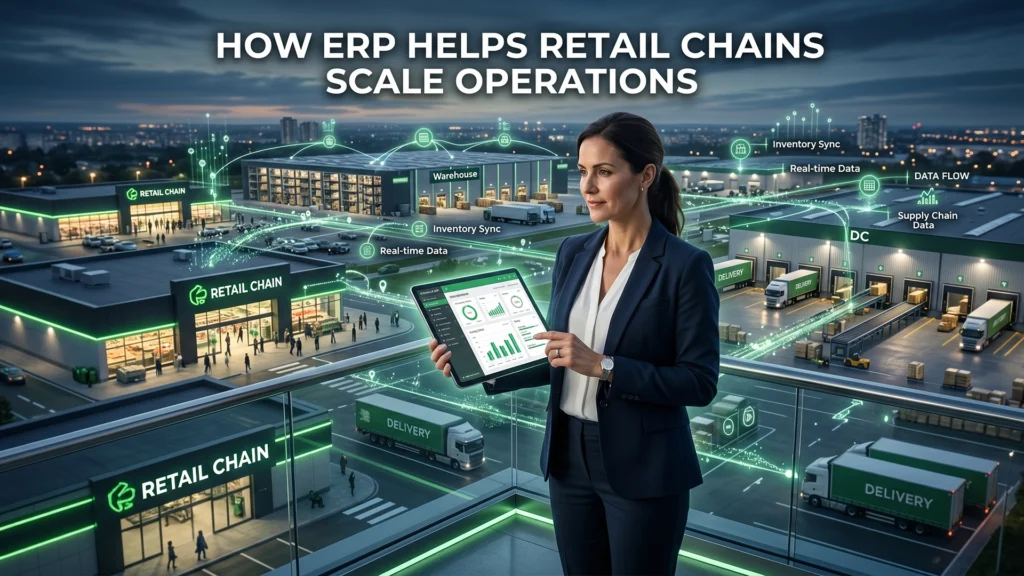
Stage 3: Regional Retail Chain (20–50 Locations)
Challenges
- Operational inconsistency
- Departmental silos
- Supply chain complexity
ERP Benefits
- Integrated workflows
- Standardized processes
- Improved collaboration
Stage 4: Enterprise Retail Network (50+ Locations)
Challenges
- Governance
- Compliance
- Scalability
ERP Benefits
- Enterprise-wide visibility
- Strategic reporting
- Long-term growth support
Signs Your Retail Chain Needs an ERP System
You may be ready for ERP if:
- Inventory discrepancies occur regularly
- Reporting takes too long
- Multiple software systems don’t communicate
- Procurement processes are inefficient
- Growth is creating operational challenges
- Data accuracy is becoming a concern
- Leadership lacks visibility into performance
- Customer experiences are inconsistent
These indicators often signal that current systems are limiting growth potential.
Common ERP Implementation Considerations
Before adopting ERP, retailers should evaluate:
Business Objectives
What challenges should ERP solve?
Current Processes
Which workflows need improvement?
Data Quality
Is existing data accurate and ready for migration?
User Adoption
How will employees be trained?
Scalability Requirements
Can the ERP support future growth?
Addressing these questions early improves implementation success.
Why Choose Helionex as Your ERP Partner?
Choosing the right ERP platform is important, but choosing the right implementation partner is equally critical.
At Helionex, we understand that ERP is not just a technology project—it is a business transformation initiative. Our goal is to help retail organizations build scalable operational foundations that support growth, efficiency, and long-term success.
Our ERP Services Include
- ERP consulting and strategy
- ERP implementation planning
- Retail process optimization
- Data migration support
- System integration services
- Workforce scaling assistance
- Ongoing ERP optimization
Why Retailers Trust Helionex
Retail-Focused Expertise
We understand the unique challenges facing modern retail businesses.
Scalable Solutions
Our strategies are designed to support both current needs and future expansion.
Business-First Approach
We align technology decisions with operational and business goals.
End-to-End Support
From planning and implementation to optimization and growth, we remain a trusted partner throughout the ERP journey.
Long-Term Value Creation
Our focus extends beyond deployment to helping businesses maximize ERP ROI over time.
Whether you’re managing a growing regional chain or preparing for nationwide expansion, Helionex can help you leverage ERP technology to scale with confidence.
Conclusion
Understanding how ERP helps retail chains scale operations is essential for retailers seeking sustainable growth in an increasingly competitive market.
As businesses expand, operational complexity naturally increases. Inventory management becomes more challenging, procurement grows more demanding, reporting becomes more complicated, and customer expectations continue to rise. Without the right systems in place, these challenges can slow growth and reduce profitability.
ERP provides the centralized platform needed to overcome these obstacles. By integrating inventory, procurement, finance, supply chain management, reporting, and customer operations into a single system, ERP empowers retailers to operate more efficiently, make smarter decisions, and scale confidently.
For retail chains looking to improve visibility, streamline operations, enhance customer experiences, and support long-term growth, ERP is no longer simply an operational tool—it is a strategic investment in the future of the business.