
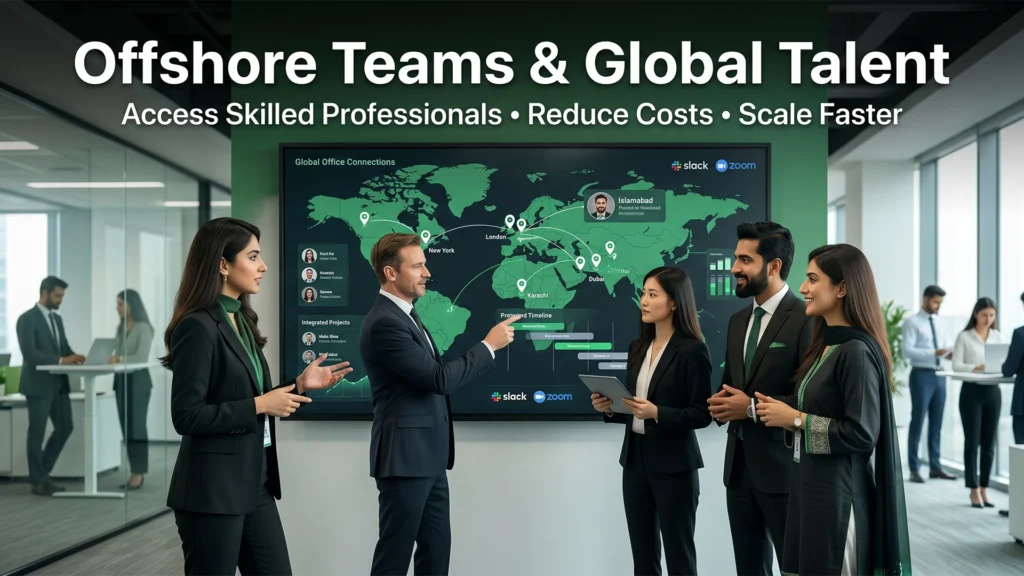
The workplace looks dramatically different today than it did just a few years ago. Businesses are no longer restricted by geography when building teams, and employees increasingly expect flexibility in how and where they work. This transformation is being fuelled by advances in digital technology, changing workforce expectations, global talent shortages, and growing pressure on businesses to scale efficiently.
For many organisations, finding qualified professionals locally has become more difficult and expensive. At the same time, remote collaboration platforms have made it easier than ever for teams to work together across countries and time zones. As a result, companies are embracing Offshore Teams & Global Talent not simply as a cost-saving measure but as a strategic workforce model that enables access to skills, innovation, and operational flexibility.
The future of work is increasingly defined by a company’s ability to attract the best talent regardless of location. Organisations that adapt to this reality are often able to innovate faster, respond more effectively to market changes, and scale with greater confidence than competitors that rely solely on local hiring.
What Are Offshore Teams and How Do They Work?
An offshore team is a group of professionals located in another country who work as an extension of a company’s internal workforce. Unlike traditional outsourcing arrangements that focus on delivering specific tasks or projects, modern offshore teams often become deeply integrated into daily business operations.
These teams may support a wide range of business functions, including software development, ERP consulting, customer support, digital marketing, data analytics, finance operations, and IT services. Team members participate in meetings, collaborate with internal stakeholders, and contribute to long-term business goals in much the same way as local employees.
The primary difference is location. Through cloud-based technologies and collaboration platforms, offshore professionals can communicate, share information, and complete projects in real time, regardless of where they are physically based.
Businesses increasingly view offshore teams as an extension of their workforce rather than a separate external resource. This shift in perspective is one of the major reasons why offshore staffing continues to grow worldwide.
Common Offshore Team Structures
- Dedicated offshore teams
- Staff augmentation models
- Managed service teams
- Hybrid workforce structures
- Global delivery centers
Each model offers different levels of flexibility, management control, and scalability depending on business objectives.
Why Is Global Talent Becoming More Important Than Local Hiring Alone?
The demand for skilled professionals continues to outpace supply in many industries. Fields such as software engineering, cybersecurity, cloud computing, artificial intelligence, and ERP implementation often experience significant talent shortages that can delay projects and limit growth opportunities. This is one of the key reasons why Offshore Teams & Global Talent have become essential for modern businesses, allowing organizations to access specialized expertise beyond local hiring constraints and keep critical projects moving without delays.
Relying solely on local recruitment creates several challenges. Businesses may face higher salary expectations, extended hiring timelines, and increased competition for a limited pool of qualified candidates. These constraints can make it difficult to achieve growth targets or execute strategic initiatives.
By adopting a global talent strategy, organizations gain access to a much larger workforce. Instead of competing for talent within a single city or region, they can recruit professionals from multiple markets with diverse backgrounds, experiences, and skill sets.
This broader access allows businesses to:
- Fill specialized roles faster
- Reduce recruitment bottlenecks
- Increase workforce flexibility
- Expand operational capacity
- Support long-term growth initiatives
The future of work increasingly favors organizations that prioritize skills and expertise over geographic location.
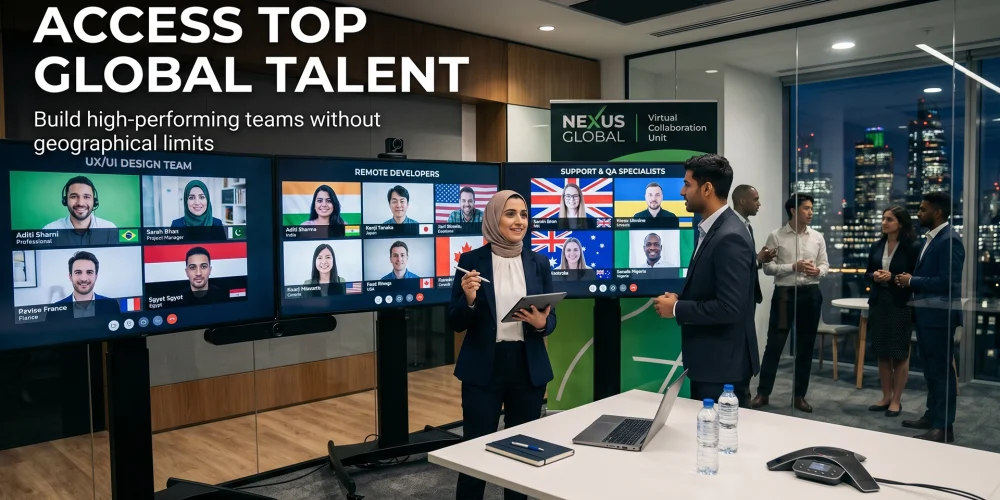
What Are the Biggest Benefits of Offshore Teams & Global Talent?
One of the most common misconceptions about offshore staffing is that it exists purely to reduce costs. While cost efficiency remains an important advantage, modern organizations are discovering that the true value of Offshore Teams & Global Talent extends far beyond labor savings, as it enables access to specialized skills, faster scaling capabilities, and greater operational flexibility in a highly competitive global market.
Access to global talent enables businesses to solve complex workforce challenges while creating a more resilient and scalable operating model. Organizations can recruit specialized expertise, accelerate project delivery, and maintain business continuity even during periods of rapid growth or market disruption.
Some of the most significant benefits include:
Access to Specialized Expertise
Many businesses struggle to find professionals with niche technical skills. Offshore staffing opens the door to highly qualified experts who may not be available locally.
Faster Business Scaling
Global recruitment significantly shortens hiring timelines, allowing companies to build teams quickly as demand increases.
Increased Workforce Flexibility
Organizations can expand or adjust team sizes based on changing project requirements without committing to lengthy local hiring cycles.
Around-the-Clock Productivity
Distributed teams operating across multiple time zones can support continuous workflows and faster project completion.
Enhanced Innovation
Diverse teams bring different perspectives, experiences, and problem-solving approaches that often lead to stronger business outcomes.
The organizations seeing the greatest success are those that view Offshore Teams & Global Talent as strategic assets rather than temporary staffing solutions.
We are introducing our Business Process Outsourcing (BPO) service, which enables companies to streamline operations by delegating non-core processes to skilled offshore teams. This directly supports the Offshore Teams & Global Talent model by improving efficiency, scalability, and operational focus.
What Challenges Do Businesses Face When Managing Offshore Teams?
While offshore workforce models offer substantial benefits, success is not automatic. Businesses that underestimate the importance of communication, leadership, and operational processes often struggle to achieve desired outcomes. This is especially true when implementing Offshore Teams & Global Talent, where cross-border coordination, cultural alignment, and structured workflows become critical factors in ensuring consistent performance and long-term success.
One of the most common challenges involves communication. Differences in language, cultural expectations, and work styles can create misunderstandings if clear processes are not established. Time zone variations can also affect collaboration when teams do not have sufficient overlap during working hours.
Another challenge involves maintaining organizational culture. Offshore professionals who feel disconnected from company goals may be less engaged and less productive. Businesses must actively integrate offshore employees into team meetings, planning sessions, and company initiatives.
Other challenges include:
- Knowledge transfer issues
- Data security concerns
- Performance management complexity
- Collaboration inefficiencies
- Compliance considerations
- Team alignment difficulties
The good news is that these challenges can be addressed through structured onboarding, strong leadership, clear documentation, and consistent communication practices.
How Are Offshore Teams Reshaping the Future of Work?
The traditional workforce model centered around physical offices and local recruitment is rapidly evolving. Businesses are increasingly building distributed organizations that prioritize access to skills over proximity.
As technology continues to improve, the distinction between local and offshore employees is becoming less relevant. Teams collaborate through cloud-based platforms, participate in virtual meetings, and contribute to shared business objectives regardless of location.
Several trends are accelerating this transformation:
- Remote-first business models
- Skills-based hiring strategies
- Digital transformation initiatives
- Workforce decentralization
- Global talent marketplaces
- Artificial intelligence adoption
- Flexible employment structures
Organizations that embrace these trends are often better positioned to compete in dynamic markets where speed, innovation, and adaptability are critical success factors. In this context, Offshore Teams & Global Talent play a crucial role by enabling businesses to rapidly access skilled professionals, scale operations efficiently, and maintain continuous innovation across distributed teams worldwide.
Which Workforce Model Is Best for Modern Businesses?
There is no single workforce model that works for every organization. The ideal approach depends on company size, growth stage, industry requirements, and long-term objectives.
Most businesses today fall into one of four workforce categories:
Local Workforce Model
All employees are located within the same region. While this approach simplifies management, it can restrict access to talent and increase recruitment costs.
Hybrid Workforce Model
A combination of office-based and remote employees. This model offers greater flexibility while maintaining some level of physical collaboration.
Offshore Augmentation Model
Organizations supplement internal teams with offshore professionals to fill skill gaps or support specific initiatives. This approach is a core part of leveraging Offshore Teams & Global Talent, allowing businesses to extend their in-house capabilities with specialized expertise from global markets while maintaining flexibility, scalability, and faster execution of strategic projects.
Global-First Workforce Model
Businesses recruit talent globally from the outset, creating fully distributed teams designed for scalability and flexibility.
For many growth-focused organizations, the global-first model is emerging as the most sustainable long-term strategy because it maximizes access to talent while reducing geographic limitations.
How Can Businesses Successfully Build Offshore Teams?
Building a successful offshore team requires far more than hiring remote professionals. Companies must create systems, processes, and leadership structures that support collaboration across borders. When working with Offshore Teams & Global Talent, this becomes even more important, as structured governance, clear communication channels, and well-defined workflows ensure that distributed teams remain aligned, productive, and fully integrated with overall business objectives.
The most successful organizations approach offshore staffing as a long-term workforce strategy rather than a short-term solution.
Key steps include:
Define Clear Objectives
Determine whether offshore hiring is intended to support growth, improve efficiency, access specialized skills, or accelerate innovation.
Identify the Right Roles
Not every position is equally suited for offshore staffing. Businesses should focus on functions that can be effectively managed remotely.
Create Governance Processes
Establish communication standards, performance expectations, reporting structures, and accountability measures.
Invest in Collaboration Technology
Tools such as Microsoft Teams, Slack, Jira, Zoom, and Asana help distributed teams remain connected and productive.
Prioritize Team Integration
Offshore professionals should be included in company meetings, training programs, and strategic discussions to ensure alignment and engagement.
Organizations that invest in these foundations often achieve stronger results and higher long-term retention rates.
We are introducing our service for Legacy Migration & System Integrations, designed to help businesses modernize outdated systems and enable seamless collaboration across offshore and global teams. This ensures that legacy infrastructure does not become a barrier when scaling Offshore Teams & Global Talent across modern digital ecosystems.
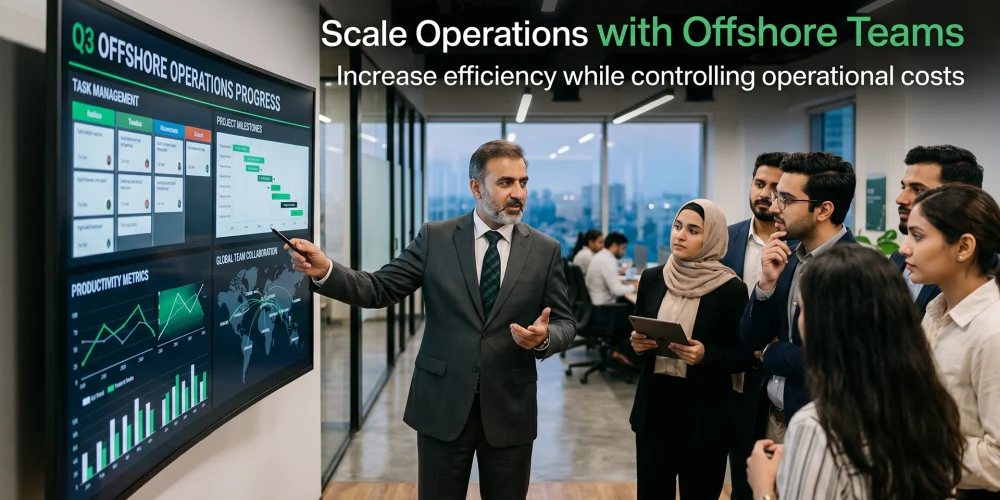
How Will Artificial Intelligence Impact Offshore Teams & Global Talent?
Artificial intelligence is already transforming workforce management and recruitment practices. Rather than replacing global talent, AI is expected to increase demand for specialized professionals who can implement, manage, and optimize emerging technologies.
AI-powered tools help organizations:
- Identify qualified candidates faster
- Improve recruitment efficiency
- Analyze workforce trends
- Predict future skill requirements
- Support employee development
At the same time, businesses increasingly require experts in machine learning, cloud infrastructure, automation, cybersecurity, and data analytics. Many of these skills are in short supply locally, making global talent acquisition even more important.
The combination of AI and offshore staffing is likely to become a defining feature of workforce strategy over the next decade.
Why Should Businesses Invest in Offshore Teams & Global Talent Now?
Companies that delay adapting to workforce transformation may find themselves struggling to compete for talent, scale operations, and maintain profitability in increasingly competitive markets.
The organizations leading their industries are not waiting for workforce trends to mature. They are actively building distributed teams, accessing global expertise, and creating scalable operating models that support long-term growth.
Investing in Offshore Teams & Global Talent today allows businesses to:
- Access hard-to-find skills
- Improve operational agility
- Accelerate growth initiatives
- Enhance innovation capacity
- Strengthen workforce resilience
- Prepare for future market demands
As workforce expectations continue evolving, the ability to attract and manage global talent will become a major competitive advantage.
Why Choose Helionex as Your Offshore Staffing Partner?
Finding talent is only one part of building a successful offshore workforce. The real challenge lies in creating a team structure that aligns with your business objectives, integrates seamlessly with existing operations, and delivers measurable results.
At Helionex, we help organizations move beyond traditional outsourcing by building scalable workforce solutions centered around performance, collaboration, and long-term success.
What Makes Helionex Different?
- Access to highly skilled global professionals
- Dedicated offshore team solutions
- ERP, IT, and digital transformation expertise
- Flexible staffing models
- Strong onboarding and integration processes
- Transparent communication and governance
- Long-term partnership approach
Our goal is not simply to fill positions. We help businesses build high-performing teams capable of driving growth, innovation, and operational excellence.
What Does the Future Hold for Offshore Teams & Global Talent?
The future of work will be increasingly global, digital, and skills-driven. Companies that embrace workforce flexibility and access to international talent pools will be better equipped to navigate economic uncertainty, technological change, and evolving customer expectations.
Offshore Teams & Global Talent are no longer alternative workforce models. They are becoming fundamental components of modern business strategy. Organizations that learn how to leverage global expertise effectively will gain significant advantages in scalability, innovation, and long-term competitiveness.
The question is no longer whether global talent will shape the future of work. The question is how quickly businesses can adapt to take advantage of the opportunities it creates.