The Benefits of Outsourcing allow businesses to focus on growth while experts handle critical tasks efficiently. With MICS 365 support and cloud and infrastructure management, operations run smoothly and securely. Outsourcing data entry and back-office operations frees internal teams for strategic work, while dedicated offshore teams provide skilled support on demand. Workforce scaling and management …
The Benefits of Outsourcing allow businesses to focus on growth while experts handle critical tasks efficiently. With MICS 365 support and cloud and infrastructure management, operations run smoothly and securely. Outsourcing data entry and back-office operations frees internal teams for strategic work, while dedicated offshore teams provide skilled support on demand. Workforce scaling and management ensure flexibility, and professional network monitoring and security support safeguard data. Together, these solutions make outsourcing a smart way to boost efficiency and productivity.
- mics 365 support
- Cloud and infrastructure management
- Data entry and back-office operations
- Dedicated offshore teams
- Workforce scaling and management
- Network monitoring and security support
The main goal is simple: allow the business to focus on growth while experts handle specific tasks more efficiently.
Why Growing Businesses Consider benefits of Outsourcing
Growing businesses often face a common problem: they need more capacity, but they may not be ready to hire large internal teams. Recruitment takes time, training costs money, and managing new departments adds extra pressure.
The Benefits of Outsourcing give businesses a flexible way to solve this challenge. It allows them to expand operations without building everything from scratch.
A growing business may consider outsourcing when:
- The internal team is overloaded
- Hiring full-time staff is becoming expensive
- The company needs specialist skills quickly
- Customer support demand is increasing
- IT systems need constant monitoring
- Business operations are becoming harder to manage
- The company wants to reduce fixed costs
- Leadership wants to focus more on strategy and growth
When used correctly, outsourcing becomes more than a cost-saving method. It becomes a business growth model.Growing a business is exciting, but it also brings pressure. As sales increase, operations become more complex, customer expectations rise, and internal teams often struggle to manage everything at the same speed. This is where outsourcing advantages becomes a smart growth strategy.
Leveraging the Benefits of Outsourcing, businesses can hand over specific tasks, processes, or technical functions to external experts. Instead of hiring full internal teams for every department, companies can work with skilled professionals who already have the tools, systems, and experience needed to deliver results.
For growing businesses, outsourcing is not only about saving money. It is about improving speed, flexibility, quality, and focus. Whether a business needs IT support, business process outsourcing, ERP support, customer service, back-office help, or dedicated offshore teams, value of outsourcing can create room for faster and more stable growth.
What Is Outsourcing?
Outsourcing means hiring an external company or specialist team to handle specific business functions. These functions can include IT support, customer service, finance, HR, software development, ERP support, administration, data management, and other operational tasks.
Instead of managing everything in-house, a business can outsource selected work to a reliable service provider. This helps the company reduce internal workload, access specialised skills, and improve operational efficiency.
For example, a growing business may outsource the following:
- IT support and helpdesk services
- Business process outsourcing
- Customer support
- ERP and Microsoft Dyna
1. Outsourcing Helps Reduce Operating Costs
One of the biggest benefits of outsourcing is cost control. Hiring in-house employees requires salaries, benefits, training, office space, software tools, equipment, and management time. These costs can grow quickly, especially when a business is scaling.
Outsourcing helps businesses reduce many of these fixed costs. Instead of building a full department internally, a company can pay for the services it needs.
This can help reduce costs related to:
- Recruitment
- Employee training
- Office space
- Software tools
- IT infrastructure
- Management overhead
- Full-time salaries
- Operational delays
For growing businesses, this is valuable because cash flow matters. Outsourcing allows companies to invest more money into sales, marketing, product development, customer experience, and expansion.
However, outsourcing should not be seen as simply choosing the cheapest option. The goal is to find the right balance between cost, quality, reliability, and long-term value.
2. Outsourcing Gives Access to Skilled Talent
Many growing businesses need expert support but cannot always hire specialists quickly. Finding skilled professionals in IT, ERP, cybersecurity, customer support, finance, or operations can take months. The Advantages of Outsourcing solve this challenge by providing immediate access to trained professionals, allowing businesses to maintain efficiency and focus on growth without the delays of traditional hiring.
With the right outsourcing partner, a business can access:
- IT support specialists
- ERP consultants
- Cloud infrastructure experts
- Customer service teams
- Back-office professionals
- Data management teams
- Technical support engineers
- Business process experts
- Dedicated offshore teams
This demonstrates the Benefits of outsourcing for tech-driven businesses and service providers. They often need reliable technical support but may not want to build a large internal department immediately.
Outsourcing allows them to use expert talent when needed and scale the team as the business grows.
3. How benefits of outsourcing Improves Business Efficiency
As a business grows, internal teams often spend too much time on routine tasks. These tasks may be important, but they can distract employees from higher-value work.
The Benefits of Outsourcing include improved efficiency, as internal teams can focus on their core strengths while external experts manage repetitive, technical, or process-heavy tasks more effectively.
For example:
- IT teams can focus on innovation while outsourced support handles helpdesk tasks.
- Management can focus on strategy while outsourced teams handle admin work.
- Sales teams can focus on closing deals while outsourced teams manage data entry or customer support.
- Operations teams can focus on growth while a partner manages back-office processes.
This division of work improves speed and productivity. It also reduces burnout because employees are not overloaded with tasks outside their main role.

4. Outsourcing Allows Businesses to Focus on Core Activities
The Advantages of Outsourcing allow businesses to concentrate on core activities that directly create value. For a technology company, this includes product development, client strategy, and innovation, while service providers can focus on customer relationships, project delivery, and business growth, leaving specialised or repetitive tasks to external experts.
When internal teams spend too much time on non-core tasks, growth slows down. Outsourcing helps solve this by moving supporting tasks to external experts.
Common non-core tasks that can be outsourced include:
- IT maintenance
- Payroll support
- Customer service
- Administrative work
- Data processing
- Technical support
- System monitoring
- Back-office operations
This helps leadership and internal teams focus on high-impact business areas.
For example, a company using Helionex for IT support or business process outsourcing can enjoy the value of Outsourcing by spending less time on daily operational issues and more time enhancing customer experience, expanding services, and driving long-term growth.
5. Outsourcing Supports Faster Scaling
Scaling is one of the biggest challenges for growing businesses. The Advantages of Outsourcing help companies manage new clients or enter new markets without overloading internal teams, providing skilled support to handle the extra workload efficiently.
Outsourcing gives businesses the flexibility to scale faster. Instead of waiting months to recruit and train new employees, businesses can quickly expand capacity through an outsourcing partner.
This is useful when a company needs to:
- Increase customer support coverage
- Add technical support capacity
- Launch a new service
- Handle seasonal demand
- Support more clients
- Expand into new markets
- Build dedicated offshore teams
- Manage sudden workload increases
The biggest advantage is flexibility. A business can scale up when demand increases and adjust resources when demand slows down. This makes outsourcing a safer growth option compared to permanent hiring during uncertain periods.
When your business needs to expand quickly without hiring delays, Helionex’s Workforce Scaling & Management services can help you build flexible, accountable teams. This supports faster project delivery, better resource control, and scalable growth as business demand changes.
- Outsourcing Can Improve Customer Experience
Customer experience is critical for business growth. The Advantages of Outsourcing allow companies to meet customer expectations for faster responses, better support, and consistent service quality while internal teams focus on strategic priorities.
If internal teams are overloaded, response times become slower. This can affect customer satisfaction and damage the brand’s reputation.
Outsourcing customer support, IT support, or technical help desk services can improve the customer experience by providing the following:
- Faster response times
- Extended support hours
- Better issue tracking
- Dedicated support teams
- Consistent service quality
- Clear escalation processes
- Multichannel communication support
For businesses that serve clients across different time zones, outsourcing can also help provide longer support coverage.
This is especially useful for technology companies, SaaS providers, and service businesses that need reliable customer communication and technical support.
7. Outsourcing Helps Reduce Business Risk
Many growing businesses face operational risks such as system downtime, poor customer support, compliance errors, data security issues, staff shortages, and process failures. The Benefits of Outsourcing help mitigate these risks by providing skilled external support, ensuring smooth operations while internal teams focus on growth.
A good outsourcing partner can help reduce these risks by bringing structured systems, trained teams, and proven processes.
Outsourcing can support risk reduction through:
- Clear service level agreements
- Defined responsibilities
- Regular reporting
- Backup support teams
- Data security practices
- Compliance awareness
- Performance monitoring
- Standard operating procedures
For example, outsourcing IT support can help a business monitor systems, respond to issues, and reduce downtime. Outsourcing back-office processes can improve accuracy and reduce delays.
However, outsourcing also needs proper management. Businesses should choose partners carefully and define expectations clearly from the beginning.
8. Outsourcing Gives Access to Better Tools and Technology
Many outsourcing providers already use professional tools, platforms, and systems to manage work efficiently. This saves businesses from buying, setting up, and maintaining everything themselves.
Depending on the service, an outsourcing partner may already have tools for:
- Ticket management
- Customer support
- ERP support
- Cloud monitoring
- Reporting dashboards
- Data security
- Workflow management
- Performance tracking
- Communication and collaboration
For a growing business, this can be a major advantage. Instead of investing heavily in tools and training, the company can benefit from the provider’s existing systems.
Helionex, for example, works across areas such as IT support, cloud infrastructure, ERP-related support, identity and access management, and network monitoring. This makes outsourcing more valuable for businesses that need both operational and technical support.
9. Outsourcing Improves Flexibility
Business needs to change quickly. A company may need more support during a product launch, busy season, migration project, or client expansion. Later, the workload may become lighter.
Hiring full-time staff for temporary demand can create unnecessary long-term costs. The Advantages of Outsourcing provide businesses with flexibility, allowing them to scale resources up or down as needed without the overhead of permanent hires.
With outsourcing, companies can adjust support based on:
- Project size
- Business growth stage
- Seasonal workload
- Customer demand
- Technical complexity
- Budget limits
- Market changes
This flexibility helps businesses stay lean while still having access to skilled support.
It also allows companies to test new services or markets without immediately making large hiring commitments.
10. Outsourcing Creates Long-Term Strategic Growth
The best outsourcing partnerships are not only about completing tasks. They support long-term business growth.
When outsourcing is managed properly, it can help a business build a stronger operating model. Internal teams can focus on strategy, while external teams support execution, systems, customer service, and daily operations.
Over time, outsourcing can help businesses:
- Improve service delivery
- Reduce operational pressure
- Increase customer satisfaction
- Strengthen technical support
- Improve process consistency
- Scale more confidently
- Control costs more effectively
- Build a more flexible workforce
This makes outsourcing a strategic decision, not just an operational shortcut.
For growing businesses, the real value comes from using outsourcing in a structured way. The right partner can support daily operations while also helping the business prepare for future growth.

How to Know If Outsourcing Is Right for Your Business
Outsourcing is useful, but it is not the right solution for every task. Businesses should use a clear decision framework before outsourcing.
A simple way to decide is to ask five questions.
1. Capacity
Is your internal team overloaded?
If your team is missing deadlines, delaying customer responses, or spending too much time on routine tasks, outsourcing may help reduce workload.
2. Capability
Do you need skills that your internal team does not currently have?
If you need IT experts, ERP support, cloud specialists, or trained customer support teams, outsourcing can give you faster access to those skills.
3. Cost
Would hiring internally create high fixed costs?
If building an internal team is too expensive or too slow, outsourcing can offer a more flexible cost model.
4. Control
Can the work be managed with clear processes, KPIs, and reporting?
Tasks with clear expectations are usually easier to outsource successfully.
5. Continuity
Do you need long-term support or scalable capacity?
If your business needs ongoing help, outsourcing can provide stable support without constant recruitment.
What Should a Growing Business Outsource First?
A growing business should begin by outsourcing tasks that are important but not central to its core strategy, taking full advantage of the value of Outsourcing to free internal teams for high-value work and strategic growth.
Good first areas to outsource include:
- IT support
- Customer support
- Back-office operations
- Data entry
- ERP support tasks
- Technical helpdesk
- Cloud monitoring
- Administrative processes
- Reporting and documentation
- Routine operational tasks
Businesses should avoid outsourcing highly sensitive or strategic work too early unless they have strong governance, legal protection, and a trusted partner.
A good rule is simple: outsource tasks that slow your team down but can be handled better with clear systems, documentation, and expert support. If your internal team is spending too much time on repetitive operational tasks, Helionex’s Business Process Outsourcing services can help you streamline daily workflows and improve efficiency.
This is especially useful for growing businesses that want cost-effective support without building large in-house departments.
Outsourcing vs Hiring In-House
Both outsourcing and in-house hiring have value. The right choice depends on business needs, budget, urgency, and control requirements.
Hiring in-house is better when:
- The role is central to your long-term strategy
- You need daily internal collaboration
- The work requires deep company knowledge
- You want full control over the process
- The workload is permanent and predictable
Outsourcing is better when:
- You need skills quickly
- You want to reduce fixed costs
- Your internal team is overloaded
- You need flexible scaling
- The work can be managed with clear KPIs
- You need technical or operational expertise
- You want to improve speed without heavy hiring
Many growing businesses use both models. They keep strategic roles in-house and outsource support functions to improve capacity and efficiency.
Common Risks of Outsourcing
Outsourcing has many benefits, but businesses should also understand the risks. A poor outsourcing setup can lead to communication problems, quality issues, security concerns, or hidden costs.
Common outsourcing risks include:
- Poor communication
- Lack of clear expectations
- Weak performance tracking
- Data security concerns
- Hidden service costs
- Low-quality delivery
- Dependency on one provider
- Slow issue resolution
- Poor cultural fit
- Lack of documentation
These risks can be reduced with the right planning.
Before outsourcing, businesses should define:
- Scope of work
- KPIs
- Reporting process
- Communication channels
- Security requirements
- Escalation process
- Service level agreement
- Timeline expectations
- Ownership and responsibilities
A reliable outsourcing partner should be transparent, structured, and willing to work with clear performance standards.
How to Choose the Right Benefits of Outsourcing Partner?
Choosing the right outsourcing partner is critical. The Advantages of Outsourcing are maximized when the partner understands your business goals and provides reliable support, rather than simply opting for the cheapest option.
Before selecting a provider, check these points:
- Do they understand your industry?
- Do they have relevant technical or operational expertise?
- Can they provide dedicated teams?
- Do they offer clear communication?
- Can they work with service level agreements?
- Do they provide reporting and performance tracking?
- Do they understand security and compliance?
- Can they scale with your business?
- Do they have experience with similar business needs?
- Do they offer long-term support, not just short-term task completion?
For tech-driven businesses, it is also important to check whether the provider can support systems such as ERP platforms, cloud infrastructure, IT support, network monitoring, and identity access management.
This is where Helionex can help businesses that need outsourcing support with a strong technical and operational foundation.
Why Helionex Is a Strong Fit for Growing Businesses
Helionex supports businesses that want to grow with better systems, stronger operations, and reliable technical support. For companies that need outsourcing, offshore teams, IT support, ERP help, or business process support, Helionex provides a practical way to increase capacity without adding unnecessary internal pressure.
Helionex can support growing businesses through services such as:
- Business Process Outsourcing
- Dedicated ERP and IT teams
- Workforce scaling and management
- 24/7 IT support
- Cloud and infrastructure support
- Identity and access management
- Network monitoring and security
- Microsoft Dynamics 365 support
- Operational and technical support teams
This makes Helionex useful for businesses that want more than basic outsourcing. It helps companies build a more stable, scalable, and technology-supported operating model.
Best-Fit and Bad-Fit Scenarios for Outsourcing
The Benefits of Outsourcing are greatest when a business has clear goals and processes. Without proper planning or defined expectations, outsourcing may not deliver the desired results, highlighting the importance of strategic preparation.
Outsourcing is a good fit when:
- Your team is overloaded
- You need specialist skills quickly
- You want to reduce fixed costs
- Your business is growing fast
- You need flexible team capacity
- You want better operational efficiency
- You need reliable IT or technical support
- You can define the work clearly
Outsourcing may not be a good fit when:
- The task is highly strategic and confidential
- You do not have clear goals
- You cannot define the scope
- You want full control over every small decision
- You are choosing only based on the lowest price
- You are not ready to communicate regularly with the provider
The best results come when outsourcing is planned as a partnership, not just a quick way to remove work from the internal team.
Final Thoughts
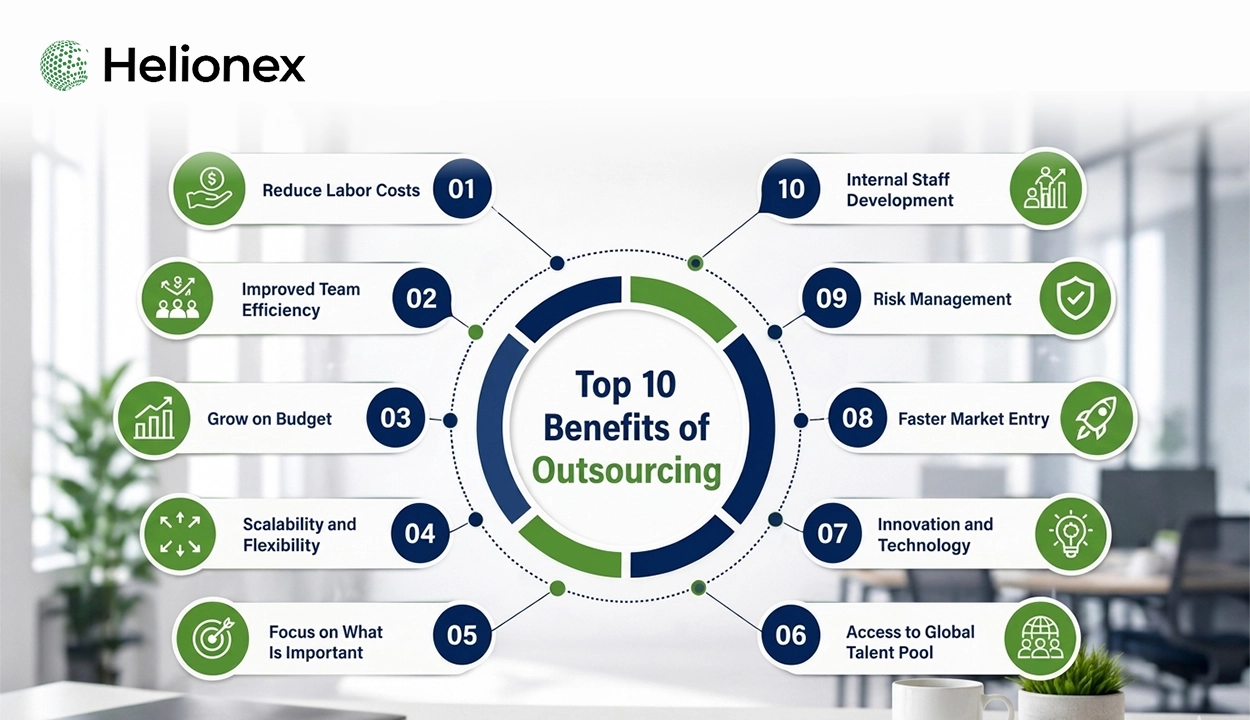
The Benefits of Outsourcing make it a powerful growth strategy for businesses looking to scale faster, reduce costs, access expert talent, and improve operational efficiency. It enables companies to focus on their core activities while experienced teams handle specialized business functions.
The top advantages of outsourcing for growing businesses include cost savings, better productivity, faster scaling, stronger customer support, access to specialised talent, improved flexibility, and reduced operational pressure.
However, outsourcing works best when it is planned carefully. Businesses should define their goals, choose the right partner, set clear expectations, and measure performance through KPIs and service level agreements.
For growing businesses that need reliable outsourcing, IT support, ERP support, BPO, or dedicated offshore teams, Helionex can provide the structure and expertise needed to support long-term growth.
Outsourcing should not be seen as losing control. When done correctly, it gives businesses more control over cost, capacity, quality, and growth.
FAQs
1. What are the main benefits of outsourcing for growing businesses?
The main benefits include lower operating costs, access to skilled talent, better efficiency, faster scaling, improved customer support, reduced risk, and more focus on core business activities.
2. Is outsourcing cheaper than hiring in-house?
Outsourcing can be more cost-effective because it reduces recruitment, training, salaries, office space, and infrastructure costs. However, the total cost depends on the service type, scope, quality requirements, and support level.
3. What tasks should a growing business outsource first?
A growing business can start by outsourcing IT support, customer support, back-office operations, data entry, ERP support, technical helpdesk, cloud monitoring, and routine administrative tasks.
4. Is outsourcing risky?
Outsourcing can have risks such as poor communication, weak quality control, data security concerns, and hidden costs. These risks can be reduced by choosing a reliable partner, setting clear KPIs, and using proper service agreements.
5. How does outsourcing help business growth?
Outsourcing helps growth by giving businesses more capacity, expert support, flexible scaling, and better cost control. It allows internal teams to focus on strategy, sales, customer relationships, and innovation.