The Top ERP Implementation Challenges & Solutions include poor planning, data migration issues, resistance to change, and budget overruns. These challenges can be overcome with clear goals, structured implementation, proper training, and the right ERP partner.Beyond these basics, businesses also need to consider deeper factors such as organisational readiness, system compatibility, and long-term scalability. Many …
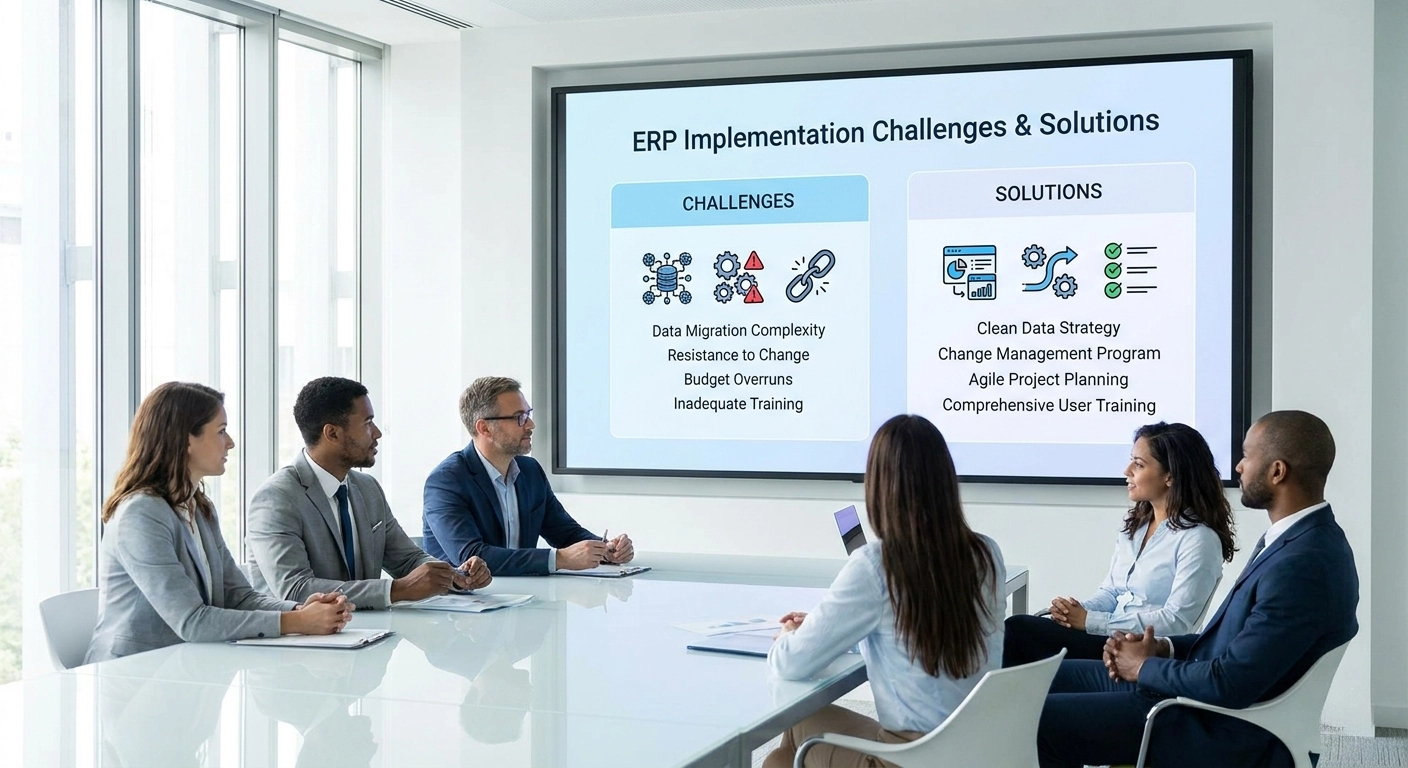
The Top ERP Implementation Challenges & Solutions include poor planning, data migration issues, resistance to change, and budget overruns. These challenges can be overcome with clear goals, structured implementation, proper training, and the right ERP partner.
Beyond these basics, businesses also need to consider deeper factors such as organisational readiness, system compatibility, and long-term scalability. Many ERP failures don’t happen because of one big mistake—but due to multiple small oversights that compound over time.
That’s why a proactive approach is essential. Instead of reacting to problems during implementation, successful companies anticipate risks early and put mitigation strategies in place. This mindset alone can significantly improve project success rates and ROI.
Implementing an ERP system is one of the most important decisions a growing business can make. It promises better control, improved efficiency, and a unified view of operations across departments. But in reality, many ERP projects don’t go as planned.
Businesses often underestimate the complexity involved. What starts as a transformation initiative can quickly turn into delays, rising costs, and internal frustration. These challenges are not just technical—they involve people, processes, and strategic decisions.
In many cases, companies rush into ERP implementation due to competitive pressure or rapid growth, without fully understanding their internal readiness. This leads to misaligned expectations and execution gaps. Additionally, ERP systems impact nearly every department, meaning even minor issues can ripple across the organization.
That’s why understanding the Top ERP Implementation Challenges & Solutions is critical before you begin. This guide doesn’t just list problems—it helps you make smarter decisions, avoid costly mistakes, and implement ERP with confidence.
ERP Readiness Checklist
Before diving into the Top ERP Implementation Challenges & Solutions, ask yourself:
- Do you have clearly defined business processes?
- Is your existing data clean and structured?
- Do you have leadership support?
- Are your teams ready for change?
- Do you have a realistic budget and timeline?
If the answer to most of these is “no,” your ERP risks increase significantly. Readiness is often the difference between success and failure.
Many organisations overlook this step and jump directly into vendor selection or system configuration. However, without internal alignment, even the best ERP system cannot deliver expected results. Readiness is not just about systems—it’s about mindset, processes, and organisational discipline.
Taking time to assess your current state helps identify gaps early, allowing you to address them before implementation begins. This reduces delays, minimizes risks, and ensures smoother adoption across teams.
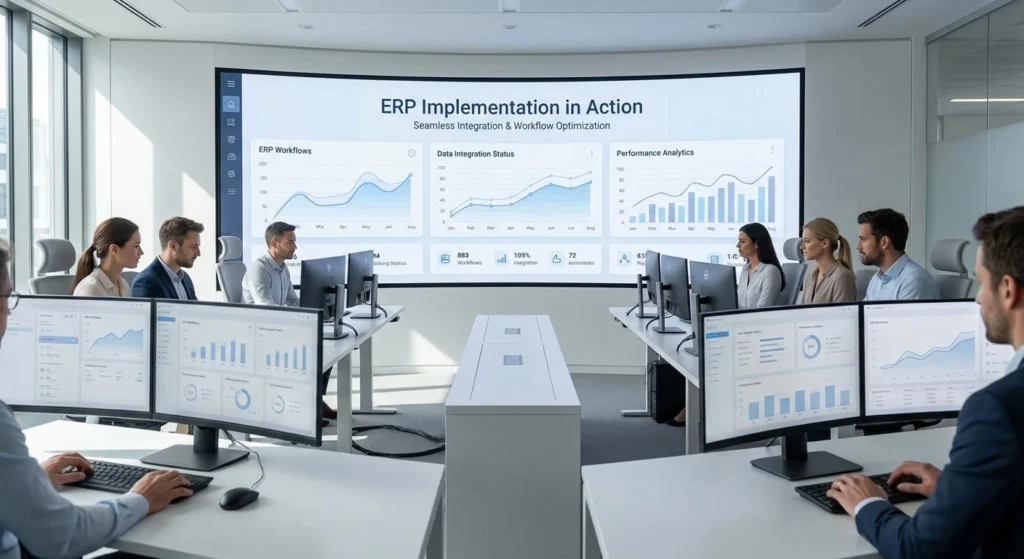
Top ERP Implementation Challenges & Solutions
Lack of Clear Business Goals
Challenge
Many ERP projects fail before they even begin—simply because there’s no clear direction. Businesses adopt ERP thinking it will “fix everything,” without defining what success actually looks like.
This often leads to conflicting expectations between departments. For example, finance may expect better reporting, while operations focus on process automation. Without alignment, the system ends up trying to satisfy everyone but delivering value to no one effectively.
Solution
- Define measurable KPIs
- Align ERP with strategy
- Identify key pain points
- Create roadmap
In addition, involve stakeholders from all major departments during the goal-setting phase. This ensures alignment and avoids future conflicts. When everyone agrees on what success looks like, decision-making becomes faster and more effective throughout the implementation process.
Poor Change Management
Challenge
ERP implementation is not just a system upgrade—it’s a cultural shift. Employees often feel uncertain or resistant.
Resistance doesn’t always appear as direct opposition. It can show up in subtle ways—like avoiding system usage, making errors, or sticking to old processes. These behaviors can significantly impact ERP effectiveness.
Solution
A structured approach to Change Management:
- Communicate clearly
- Involve teams
- Provide training
- Offer support
Beyond training, organizations should focus on building a culture of adaptability. Encourage feedback, recognize early adopters, and create internal champions who can guide others. When employees feel ownership, adoption improves dramatically.
Data Migration Issues
Challenge
Data migration is often underestimated. Poor-quality data leads to inaccurate outputs.
Legacy systems often contain years of inconsistent data, making migration complex. If this data is transferred without validation, it can compromise the entire ERP system’s reliability.
Solution
Managing Data Migration:
- Clean data
- Remove duplicates
- Test migrations
- Validate accuracy
Additionally, create a data governance strategy to maintain quality after migration. ERP is not a one-time setup—data must remain accurate over time to ensure reliable decision-making.
Budget Overruns
Challenge
Costs increase due to hidden complexities.
Many businesses underestimate indirect costs such as training, downtime, and internal resource allocation. These hidden factors often push budgets beyond initial estimates.
Solution
- Add buffer
- Prioritize features
- Track costs
It’s also important to continuously review budget allocation during implementation. Regular financial checkpoints help identify overspending early and allow corrective actions before costs spiral out of control.
Over-Customization
Challenge
Too much customization increases complexity.
While customization may seem beneficial initially, it can create long-term challenges such as upgrade limitations and higher maintenance costs.
Solution
- Use standard features
- Limit customization
Focus on adapting business processes to the ERP system where possible. Modern ERP platforms are designed with best practices in mind, and leveraging these can simplify operations significantly.
Integration Challenges
Challenge
Disconnected systems create inefficiencies.
Without proper integration, teams may rely on manual data entry, increasing errors and reducing productivity.
Solution
Use strong API Integration:
- Plan early
- Test thoroughly
Additionally, consider long-term scalability when planning integrations. As your business grows, new tools and systems will need to connect seamlessly with ERP.
Inadequate Training
Challenge
Users don’t understand the system.
Lack of confidence in using ERP often leads employees to revert to old methods, reducing system effectiveness.
Solution
- Role-based training
- Continuous learning
Investing in ongoing training programs ensures that employees stay updated and confident. This not only improves productivity but also maximizes ROI from ERP investment.
Unrealistic Timelines
Challenge
Rushed projects fail.
Trying to implement ERP too quickly often results in incomplete testing and system errors.
Solution
- Phase implementation
- Set realistic goals
Allow buffer time for unexpected challenges. ERP projects rarely go exactly as planned, and flexibility is key to success.
Vendor Selection Mistakes
Challenge
Wrong partner leads to failure.
A vendor that doesn’t understand your business can create a system that doesn’t align with your needs.
Solution
- Evaluate vendors
- Review case studies
Working with an experienced ERP Consultant ensures better alignment and smoother execution. A strong partner brings both technical expertise and business understanding.
Lack of Executive Support
Challenge
No leadership = no direction.
Without executive backing, ERP projects struggle to secure resources and maintain momentum.
Solution
- Assign sponsors
- Conduct reviews
Leadership involvement ensures accountability and keeps the project aligned with business objectives. It also signals importance to the entire organisation, encouraging stronger adoption.
ERP Implementation Phases
ERP implementation follows structured stages:
- Discovery
- Design
- Implementation
- Testing
- Go-live
- Optimization
Each phase requires careful planning and collaboration. Skipping steps or rushing through phases increases the risk of failure. A phased approach allows businesses to identify issues early and make adjustments before they escalate.
Microsoft Dynamics 365 Finance & Operations (D365 F&O) is a powerful ERP solution designed for large-scale business operations. It helps organizations streamline finance, supply chain, and enterprise-level workflows with real-time visibility and automation.
At Helionex, we provide end-to-end D365 F&O implementation services tailored to business needs, ensuring smooth deployment, minimal disruption, and long-term scalability for enterprise growth.
ERP Cost Breakdown (What You’ll Actually Pay For)
ERP costs include:
- Software
- Implementation
- Customization
- Integration
- Training
Beyond direct costs, businesses should also consider indirect expenses such as employee time, productivity loss during transition, and ongoing maintenance. Understanding the full cost structure helps in better budgeting and ROI planning.
Modern retail businesses need fast, integrated, and intelligent systems to manage sales, inventory, and customer experience. Retail commerce and POS solutions help businesses unify offline and online operations with real-time data synchronization.
Helionex delivers scalable POS and retail ERP solutions that improve sales efficiency, inventory accuracy, and customer engagement across multiple channels.
Most Critical ERP Risks Ranked
- Poor planning
- Data issues
- Low adoption
- Vendor mismatch
- Budget issues
These risks are interconnected. For example, poor planning often leads to budget overruns and low adoption. Addressing root causes is more effective than treating symptoms.
Why Choose Helionex as Your ERP Partner
At Helionex, we take a structured approach:
- Discovery workshops
- ERP roadmap
- Phased implementation
- Continuous support
What sets us apart is our focus on understanding your business before implementing technology. We work closely with your team to ensure that ERP aligns with your goals and delivers measurable outcomes. Our approach minimizes risks, improves adoption, and ensures long-term success.
ERP systems require continuous improvement after implementation to stay aligned with evolving business needs. Functional support and enhancement services ensure your ERP system runs efficiently, adapts to new requirements, and delivers consistent performance.
Helionex provides dedicated ERP support to optimize workflows, fix functional gaps, and enhance system usability for long-term operational success
Conclusion
Understanding the Top ERP Implementation Challenges & Solutions helps you avoid costly mistakes and make better decisions. ERP is not just software—it’s a business transformation.
With the right strategy, preparation, and partner, ERP can unlock efficiency, improve decision-making, and drive growth. Businesses that approach ERP with clarity and discipline are far more likely to succeed and achieve long-term value.
FAQs
What are the biggest ERP implementation challenges?
Poor planning, data migration issues, and resistance to change are the biggest challenges.
How long does ERP implementation take?
Typically 3–9 months depending on complexity.
Why do ERP implementations fail?
Due to lack of planning, poor training, and wrong vendor selection.
How can ERP risks be reduced?
By proper planning, training, and working with experts.
Is ERP suitable for SMEs?
Yes, modern ERP systems are scalable for SMEs.
What affects ERP cost?
Customization, integrations, users, and training.