Building an offshore team has become one of the smartest growth strategies for modern businesses. From startups looking to reduce operational costs to enterprises aiming to scale faster, offshore teams provide access to global talent, flexibility, and round-the-clock productivity.However, building an offshore team is not as simple as hiring remote workers from another country. Many …

Building an offshore team has become one of the smartest growth strategies for modern businesses. From startups looking to reduce operational costs to enterprises aiming to scale faster, offshore teams provide access to global talent, flexibility, and round-the-clock productivity.
However, building an offshore team is not as simple as hiring remote workers from another country. Many companies struggle with communication gaps, cultural differences, productivity issues, and poor operational alignment because they approach offshore hiring without a proper strategy.
That’s why understanding How to Build an Offshore Team Successfully is critical before you begin. A successful offshore team is built on strong planning, clear communication, structured onboarding, and scalable management processes. When done correctly, offshore teams can become a long-term extension of your business rather than just an external workforce.
What Is an Offshore Team?
An offshore team is more than just a group of remote employees working from another country. It is a strategic extension of your business that helps companies increase productivity, reduce operational costs, and access highly skilled global talent. Businesses today are no longer limited by geographical boundaries when hiring developers, marketers, designers, ERP specialists, or support professionals.
This flexibility allows organizations to scale much faster while maintaining operational efficiency. Understanding How to Build an Offshore Team Successfully starts with understanding that offshore teams require the same level of structure, communication, and leadership as in-house teams.
When managed properly, offshore teams can become a long-term competitive advantage that supports business growth, innovation, and scalability across multiple departments.
An offshore team is a group of professionals located in another country who work remotely for your business. These teams may include developers, designers, marketers, ERP specialists, customer support agents, or operational staff depending on your business needs.
Businesses usually build offshore teams to:
- Access specialized global talent
- Reduce hiring and operational costs
- Scale faster without local hiring limitations
- Increase productivity across time zones
- Expand operational capacity quickly
Modern offshore teams are powered by remote collaboration tools, Agile workflows, and cloud-based systems that make communication and project management more efficient than ever before.
Why Businesses Are Building Offshore Teams
The global business landscape has changed significantly over the last few years. Companies are now prioritizing flexibility, scalability, and digital collaboration more than ever before. This shift has made offshore staffing one of the most effective business growth strategies available today.
Businesses choose offshore teams because they help reduce recruitment costs, speed up hiring, and provide access to specialized talent that may not be available locally.
In many cases, offshore teams also allow companies to operate across multiple time zones, improving productivity and customer support coverage. When learning how to build an Offshore Team Successfully, businesses must understand that offshore hiring is not only about saving money—it’s about building sustainable operational capacity that supports long-term business goals and expansion strategies.
The demand for offshore staffing has grown rapidly in recent years because businesses are under constant pressure to scale faster while controlling operational costs.
Some major advantages include:
Cost Efficiency
Offshore hiring often reduces operational and recruitment costs compared to in-house hiring.
Access to Global Talent
Businesses are no longer restricted to local hiring pools.
Faster Scaling
Companies can expand teams quickly without long recruitment cycles.
Increased Productivity
Distributed teams can support near 24/7 operations across multiple time zones.
Operational Flexibility
Businesses can scale teams up or down depending on project demands.
However, offshore success depends heavily on execution. Without proper management systems, even highly skilled offshore teams can struggle to deliver expected results.
How to Build an Offshore Team Successfully
Define Clear Business Goals
The first step in learning How to build an Offshore Team Successfully is understanding why you need an offshore team in the first place.
Many businesses fail because they hire offshore talent without defining:
- project goals
- team responsibilities
- expected outcomes
- performance KPIs
Without clarity, offshore teams may become disconnected from business objectives.
Before hiring, define:
- What roles need offshore support
- Which business problems will offshore teams solve
- Expected deliverables
- Timeline expectations
- Budget limitations
Clear goals improve decision-making, communication, and operational alignment throughout the offshore journey.
Choose the Right Offshore Team Model
Not all offshore hiring models work the same way. Choosing the right structure is essential for long-term success.
Dedicated Offshore Team
A long-term remote team fully aligned with your business.
Project-Based Offshore Team
Used for short-term projects with fixed deliverables.
Staff Augmentation
Offshore professionals integrate into your existing internal team.
Offshore Development Center (ODC)
A large-scale operational extension for enterprises.
The right model depends on:
- project complexity
- scalability needs
- management capacity
- budget
- long-term business strategy
For growing businesses, dedicated offshore teams often provide the best balance between flexibility, control, and scalability.
Best Countries for Offshore Hiring
When building an offshore team successfully, location matters significantly. Different regions offer different advantages in terms of cost, communication, technical expertise, and time zone compatibility.
Popular offshore destinations include:
- Pakistan
- India
- Philippines
- Poland
- Ukraine
- Vietnam
Businesses should evaluate:
- English proficiency
- technical expertise
- infrastructure quality
- cultural compatibility
- political stability
- cybersecurity maturity
Choosing the right offshore region improves collaboration and reduces operational friction.
Build a Strong Hiring Process
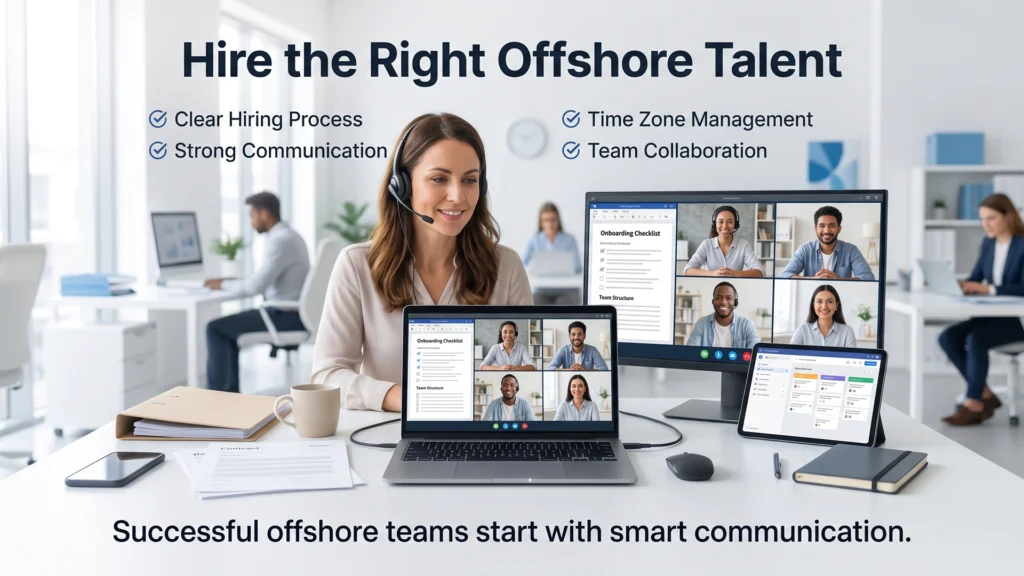
Hiring the wrong offshore talent can become extremely expensive in terms of time, productivity, and project delays. That’s why businesses need a structured offshore recruitment process rather than rushing to fill positions quickly.
Offshore hiring should focus not only on technical expertise but also on communication ability, problem-solving skills, accountability, and cultural alignment. Many offshore projects fail because businesses prioritize low costs over quality talent.
Learning How to Build an Offshore Team Successfully involves creating a hiring framework that evaluates both technical and interpersonal skills. Companies should conduct skill assessments, communication interviews, practical test projects, and behavioural evaluations before onboarding offshore employees.
A strong hiring process improves long-term team stability, reduces turnover, and ensures better operational alignment across distributed teams. One of the biggest mistakes businesses make is rushing into offshore recruitment.
A successful offshore hiring process includes:
Role Definition
Clearly define technical and operational responsibilities.
Skill Assessment
Evaluate technical ability and communication skills.
Cultural Alignment
Ensure candidates align with your company culture.
Communication Evaluation
Strong communication is critical for remote collaboration.
Trial Tasks
Use test projects before long-term onboarding.
The goal is not just to hire talent, but to build a reliable and scalable offshore operation.
Create an Effective Offshore Onboarding Process
Offshore onboarding is often underestimated, yet it directly impacts productivity, engagement, and operational success. Without a proper onboarding process, offshore employees may struggle to understand workflows, communication systems, reporting structures, and business expectations.
This confusion can lead to delays, errors, and reduced performance during the critical early stages of collaboration. Businesses learning How to Build an Offshore Team Successfully must create a structured onboarding framework that helps offshore teams integrate smoothly into company operations.
Effective onboarding should include company orientation, workflow documentation, communication guidelines, team introductions, project management systems, and role-specific expectations. The better the onboarding experience, the faster offshore employees become productive, confident, and aligned with organisational goals and team culture.
A strong onboarding process directly impacts offshore team performance.
Without proper onboarding:
- productivity decreases
- Confusion increases
- Communication gaps grow
- Operational alignment suffers
Successful onboarding should include:
- Company introduction
- Workflow documentation
- Communication protocols
- Project management systems
- Team introductions
- Role expectations
- Reporting structures
The first few weeks are critical because they shape long-term collaboration quality.
Communication Is the Foundation of Offshore Success
Communication is one of the most critical factors in offshore team management. Many offshore failures happen not because of technical issues, but because of misunderstandings, delayed responses, unclear expectations, and lack of transparency.
Offshore teams operate remotely, which means communication systems must be intentional and structured. Businesses exploring How to Build an Offshore Team Successfully should establish regular meetings, reporting systems, escalation processes, and collaboration standards from the beginning.
Strong communication builds trust, accountability, and operational clarity across distributed teams. Companies should also encourage open feedback and maintain consistent interaction between in-house and offshore staff.
One of the most important aspects of How to Build an Offshore Team Successfully is communication.
Poor communication is one of the leading reasons offshore teams fail.
Businesses should establish:
- regular meetings
- reporting structures
- collaboration standards
- escalation processes
- response time expectations
Popular remote collaboration tools include:
- Slack
- Jira
- Microsoft Teams
- Zoom
- GitHub
Consistent communication builds trust, accountability, and productivity across distributed teams.
Build an Offshore Team Management Framework
Managing offshore teams requires much more than assigning tasks and tracking deadlines. Businesses need a structured operational framework that ensures consistency, accountability, and performance visibility across remote teams.
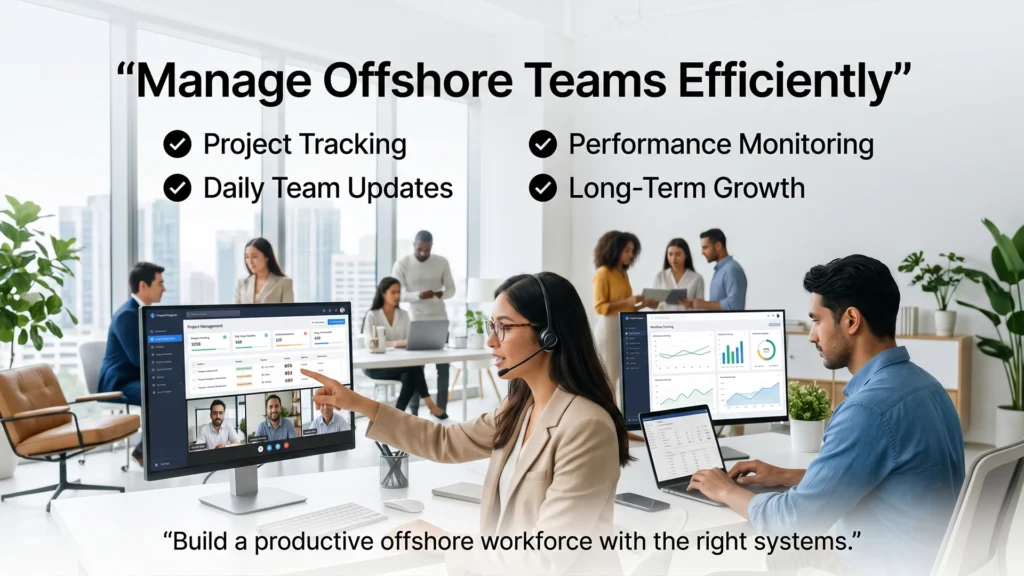
Without management systems, offshore operations can quickly become disorganised and difficult to scale. Companies learning how to build an Offshore Team Successfully should implement Agile workflows, KPI tracking systems, performance reviews, sprint planning, and operational documentation.
Strong leadership and structured governance are essential for maintaining productivity and team alignment. Offshore managers should also focus on employee engagement, workflow transparency, and continuous process improvement.
A well-designed management framework allows offshore teams to function as a reliable extension of internal operations while supporting long-term scalability and operational growth.
Managing offshore teams requires structure and operational discipline.
Businesses should establish:
- KPI tracking
- Agile workflows
- sprint planning
- accountability systems
- project documentation
- performance reviews
Using Agile methodologies improves transparency and collaboration.
Key management principles include:
- clarity
- consistency
- accountability
- visibility
- adaptability
Strong leadership is essential for maintaining offshore productivity and alignment.
Common Offshore Team Challenges
Every offshore team faces challenges, regardless of company size or industry. However, the difference between successful and unsuccessful offshore operations lies in how businesses prepare for and manage these challenges.
Common offshore issues include communication gaps, time zone differences, cultural misunderstandings, productivity concerns, employee disengagement, and cybersecurity risks.
Businesses researching How to Build an Offshore Team Successfully must understand that offshore management requires proactive planning and continuous optimization. Even successful offshore teams face challenges. Understanding these issues early helps businesses prepare proactively.
Time Zone Differences
Different working hours can delay communication.
Solution:
Create overlapping work schedules.
Cultural Differences
Work expectations may vary across regions.
Solution:
Encourage cultural awareness and clear communication.
Productivity Concerns
Remote visibility may feel limited.
Solution:
Use measurable KPIs and project tracking tools.
Security Risks
Data security becomes more complex in remote environments.
Solution:
Implement cybersecurity policies and secure access controls.
Team Isolation
Remote employees may feel disconnected.
Solution:
Encourage team-building activities and regular engagement.
Offshore Team Scaling Strategy
Scaling offshore operations requires careful planning and operational maturity. Many businesses make the mistake of hiring too quickly without establishing the systems necessary to support long-term growth.
As offshore teams expand, communication complexity, workflow management, and operational coordination become more challenging. Businesses learning How to Build an Offshore Team Successfully should prioritize scalability from the beginning by building repeatable systems, onboarding processes, and leadership structures.
As offshore operations expand, businesses also need structured workforce planning and scalable management systems. Helionex’s Workforce Scaling & Management Services help companies build sustainable remote operations through structured team scaling, operational governance, performance management, and workforce optimization strategies.
Scaling offshore teams successfully requires:
- process standardization
- operational documentation
- leadership structure
- onboarding systems
- communication governance
Businesses should avoid scaling too quickly without operational maturity.
A phased growth strategy reduces:
- productivity drops
- onboarding confusion
- management overload
- communication breakdowns
Scalable systems are more important than simply hiring more people.
Offshore Team Cost Breakdown
One of the biggest reasons businesses explore offshore staffing is cost optimization. However, many companies underestimate the full financial structure involved in offshore operations. Offshore costs go beyond salaries and include recruitment, onboarding, software tools, communication systems, training, project management, cybersecurity, and operational support.
Understanding How to Build an Offshore Team Successfully means evaluating both direct and indirect costs before building a remote workforce. The cost of offshore teams depends on:
- country
- skill level
- experience
- technology stack
- management structure
- project complexity
Typical offshore expenses include:
- salaries
- recruitment
- onboarding
- software tools
- management
- operational support
While offshore hiring reduces costs, businesses should focus on long-term ROI rather than just cheap labour.
The most successful offshore teams prioritise:
- quality
- stability
- scalability
- operational efficiency
Offshore Team Success Framework
Choosing the right offshore partner is one of the most important decisions businesses make during the offshore journey. A reliable offshore partner does much more than recruit remote employees—they help build structured, scalable, and high-performing operational systems.
At Helionex, we focus on understanding your business goals before building offshore teams that align with your workflows, culture, and long-term objectives. At Helionex, we follow a structured offshore implementation model:
Discovery
Understanding business goals and workforce requirements.
Talent Matching
Selecting professionals aligned with technical and cultural needs.
Operational Integration
Integrating offshore teams into existing workflows.
Governance
Creating accountability and communication systems.
Scaling
Expanding offshore operations strategically.
Businesses operating in retail environments also need strong integration between offshore teams, ERP systems, and commerce platforms. Helionex’s Retail Commerce & POS Solutions help businesses streamline inventory management, customer transactions, reporting, and operational workflows across multiple sales channels. This creates a more connected operational ecosystem that improves efficiency, visibility, and customer experience.
Why Choose Helionex as Your Offshore Partner
Choosing the right offshore partner is critical for long-term success. At Helionex, we focus on building offshore teams that function as a true extension of your business—not just outsourced labor.
What Makes Helionex Different?
Choosing the right offshore partner is one of the most important decisions businesses make during the offshore journey. A reliable offshore partner does much more than recruit remote employees—they help build structured, scalable, and high-performing operational systems.
At Helionex, we focus on understanding your business goals before building offshore teams that align with your workflows, culture, and long-term objectives. Businesses researching How to Build an Offshore Team Successfully need a partner that prioritizes communication, transparency, operational efficiency, and scalability.
Our approach combines technical expertise, structured management systems, Agile collaboration, and continuous support to ensure offshore success. We help businesses transform offshore staffing into a strategic growth engine rather than just a short-term outsourcing solution.
Conclusion
Understanding How to Build an Offshore Team Successfully is essential for businesses looking to scale efficiently in today’s competitive market.
Offshore teams are no longer just a cost-saving strategy—they are a powerful way to access global talent, improve operational flexibility, and accelerate business growth.
However, offshore success depends on much more than hiring remote workers. Businesses must focus on communication, onboarding, operational structure, scalability, and long-term collaboration.
With the right strategy and the right offshore partner, businesses can transform offshore teams into high-performing operational extensions that drive measurable results and sustainable growth.
FAQs
What is an offshore team?
An offshore team is a remote workforce located in another country that supports your business operations.
How do I build an offshore team successfully?
Define goals, choose the right hiring model, create communication systems, and establish strong onboarding processes.
What are the benefits of offshore teams?
Benefits include lower operational costs, access to global talent, scalability, and increased productivity.
What challenges do offshore teams face?
Common challenges include communication gaps, time zone differences, cultural barriers, and management complexity.
Which tools help manage offshore teams?
Popular tools include Slack, Jira, Zoom, Microsoft Teams, and GitHub.
Why should businesses choose Helionex for offshore staffing?
Helionex provides scalable offshore solutions, structured management frameworks, dedicated support, and long-term operational alignment.