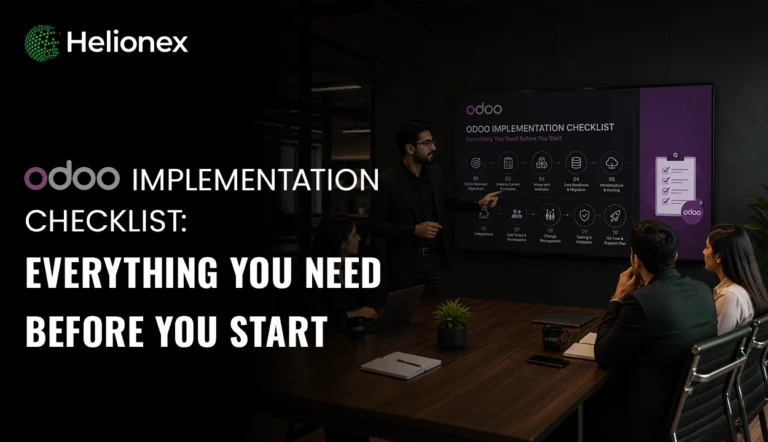
ERP implementation is a big step for any business. It can improve reporting, reduce manual work, connect departments, and give leadership a clearer view of operations. But before starting, most decision-makers have one serious question:How much will ERP implementation actually cost?The honest answer is: it depends on your business size, system requirements, data quality, number …
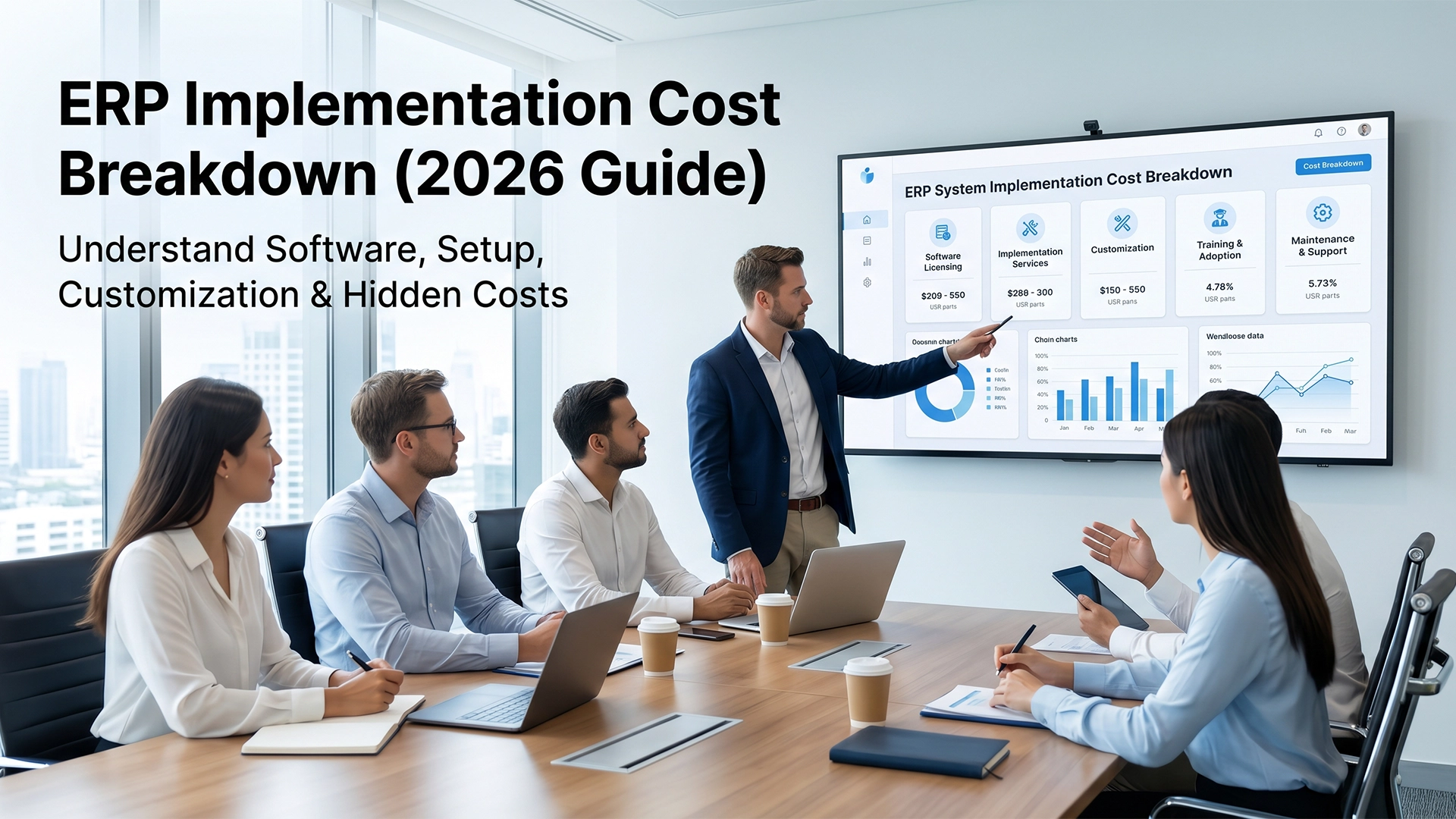
ERP implementation is a big step for any business. It can improve reporting, reduce manual work, connect departments, and give leadership a clearer view of operations. But before starting, most decision-makers have one serious question:
How much will ERP implementation actually cost?
The honest answer is: it depends on your business size, system requirements, data quality, number of users, selected ERP platform, integrations, and the level of customisation you need.
This ERP Implementation Cost Breakdown (2026 Guide) will help you understand the real cost of ERP implementation, what affects the budget, what hidden costs to watch for, and how to plan your ERP project without unpleasant surprises.
For some small businesses, ERP implementation may cost between $25,000 and $150,000. For mid-sized companies, the cost can move between $150,000 and $750,000. For large or complex enterprises, ERP implementation can reach $1 million to $5 million or more.
These numbers are not fixed prices. They are planning ranges. The final cost depends on how simple or complex your business processes are.
What Is ERP Implementation Cost?
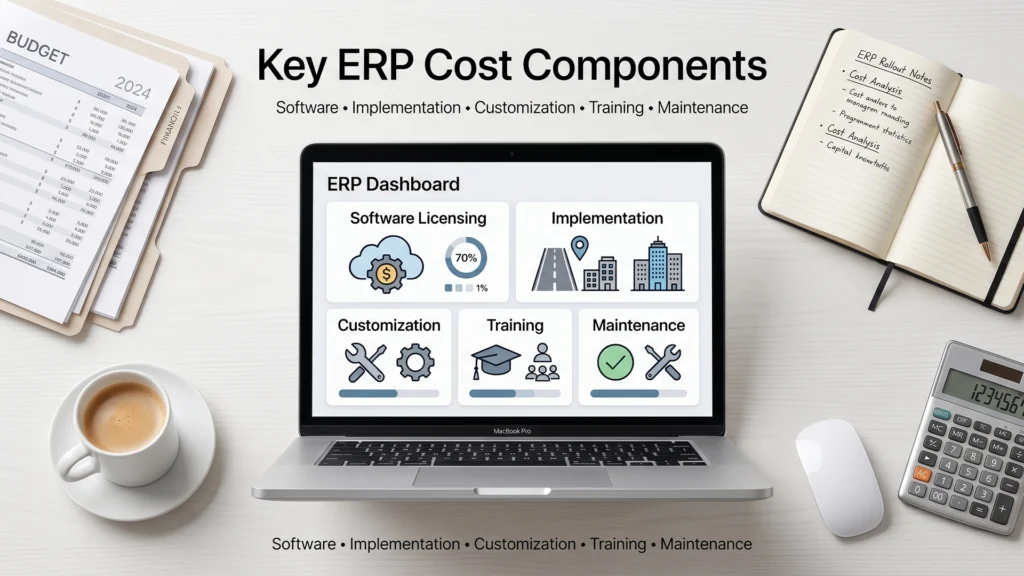
ERP implementation cost is the total amount a business spends to set up, configure, launch, and support an ERP system.
Many businesses make the mistake of thinking ERP cost means only the software license. In reality, the software is only one part of the total investment.
A complete ERP implementation usually includes:
- ERP software license or subscription
- ERP consulting services
- Business process analysis
- System configuration
- Customization
- Data migration
- Third-party integrations
- Testing and quality checks
- Employee training
- Change management
- Go-live support
- Ongoing maintenance and improvements
This is why an ERP quote can look affordable at first, but the full project budget becomes much larger once implementation work is added.
Quick ERP Implementation Cost Breakdown for 2026
Here is a simple cost view to help you understand what different businesses may need to budget.
Business Type | Estimated ERP Implementation Cost | Common Scope |
Small business | $25,000 – $150,000 | Basic finance, inventory, sales, limited users |
Growing mid-sized business | $150,000 – $750,000 | Multiple departments, integrations, reporting, training |
Large enterprise | $1M – $5M+ | Multi-location, advanced workflows, heavy customization |
Custom ERP project | $50,000 – $1M+ | Custom modules, unique workflows, advanced integrations |
This ERP Implementation Cost Breakdown (2026 Guide) is designed to help you look beyond the basic software price and understand the full project cost.
Main Factors That Affect ERP Implementation Cost
ERP cost changes from business to business because every company has different processes, departments, and system requirements.
Business Size
A small company with one office, simple accounting, and limited users will usually pay less than a company with multiple locations, warehouses, departments, and approval workflows.
The more users, departments, branches, and business units you have, the more time the implementation will take.
Number of ERP Modules
ERP systems can include many modules, such as:
- Finance
- Inventory
- Procurement
- Sales
- HR
- Payroll
- Manufacturing
- Supply chain
- Warehouse management
- CRM
- Reporting and analytics
If you only need finance and inventory, your cost will be lower. If you need finance, HR, procurement, manufacturing, POS, reporting, and integrations, the project will cost more.
Customization Needs
Customization is one of the biggest cost drivers in ERP implementation.
Standard ERP features are usually cheaper to implement. Custom workflows, custom reports, custom dashboards, and special business rules require extra development, testing, and maintenance.
Customization is not always bad. Sometimes it is necessary. But unnecessary customization can make the project expensive and difficult to manage later.
Data Migration
Data migration means moving your existing business data into the new ERP system.
This may include:
- Customer records
- Vendor records
- Product data
- Inventory data
- Financial records
- Employee records
- Sales history
- Purchase history
If your data is clean and organized, migration is easier. If your data is duplicated, incomplete, outdated, or spread across different spreadsheets and systems, migration becomes more expensive.
Third-Party Integrations
Most businesses need ERP to connect with other tools.
Common integrations include:
- CRM software
- POS systems
- eCommerce stores
- Payroll systems
- Banking tools
- Warehouse systems
- Shipping platforms
- Business intelligence tools
- Legacy software
Every integration adds planning, development, testing, and support work. This increases the total ERP implementation cost.
Deployment Model
Your ERP deployment model also affects the cost.
The main options are:
- Cloud ERP
- On-premise ERP
- Hybrid ERP
Cloud ERP usually has lower infrastructure cost because the vendor manages hosting and updates. On-premise ERP may require servers, security, IT staff, maintenance, and backup systems. Hybrid ERP combines both and may require more integration work.
Training and Change Management
ERP implementation is not only a technical project. It changes how people work every day.
Employees need proper training so they can use the new system confidently. If users are not trained well, the business may face mistakes, delays, frustration, and low adoption.
Training and change management may include:
- User training sessions
- Department-wise workshops
- Super-user training
- Process documentation
- Support guides
- Post-launch help
Skipping this step may save money in the beginning, but it can create bigger problems after go-live.
ERP Implementation Cost by Project Phase
ERP implementation happens in stages. Each stage has its own cost and importance.
Project Phase | What Happens | Cost Impact |
Discovery and planning | Requirements, goals, business process review | Medium |
Solution design | ERP structure, workflows, modules, roles | Medium |
Configuration | System setup based on business rules | High |
Customization | Custom workflows, reports, modules | Medium to high |
Data migration | Cleaning, mapping, testing, importing data | Medium to high |
Integrations | Connecting ERP with other systems | Medium to high |
Testing | Checking processes, reports, security, data | Medium |
Training | Teaching users how to use the system | Medium |
Go-live | Launching the ERP system | Medium to high |
Support | Fixes, improvements, user help | Ongoing |
A well-planned ERP project controls each phase properly. A poorly planned project usually becomes expensive during customization, migration, integrations, and post-launch support.
Hidden ERP Implementation Costs Buyers Often Miss
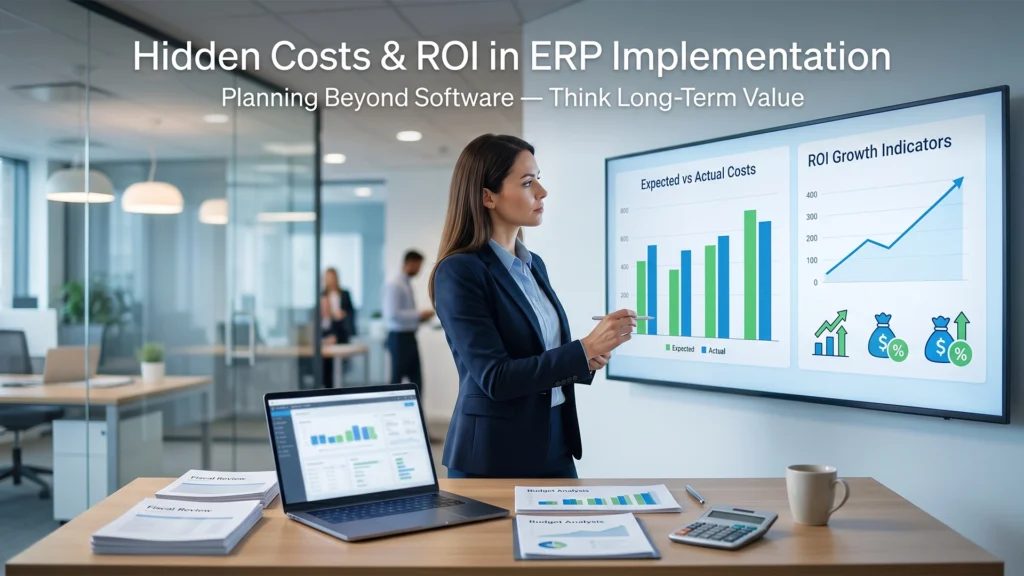
Many ERP projects go over budget because hidden costs are not planned early.
Some common hidden costs include:
- Extra customization requests
- Poor data quality
- Additional user licenses
- More training sessions
- Integration changes
- New reports requested during testing
- Delayed approvals from internal teams
- Extra testing cycles
- Post-go-live support
- Productivity loss during transition
- Change management activities
- Internal team time
These costs are not always visible at the start. That is why businesses should always keep a contingency budget for ERP implementation.
A good rule is to plan extra budget for unexpected issues, especially if your business has old systems, messy data, or complex workflows.
Businesses that need continuous ERP improvements, issue resolution, workflow optimization, and user assistance can benefit from ERP Functional Support Services designed to keep ERP systems stable, efficient, and aligned with changing business needs.
Helionex provides ongoing functional ERP support to help businesses improve reporting, enhance workflows, reduce operational disruptions, and maximize long-term ERP performance.
ERP Implementation Cost by Business Size
Small Businesses
Small businesses usually need a simpler ERP setup. They may only need core modules like finance, sales, inventory, and basic reporting.
Estimated cost: $25,000 – $150,000
Small business ERP projects are usually less expensive when:
- Users are limited
- Data is clean
- Processes are simple
- Customization is low
- Only a few modules are needed
Mid-Sized Businesses
Mid-sized businesses usually need ERP across multiple departments. They may also need integrations with CRM, eCommerce, POS, warehouse, or payroll systems.
Estimated cost: $150,000 – $750,000
Costs increase because mid-sized companies usually need:
- More users
- More modules
- Department-specific workflows
- Data migration
- Integrations
- Reporting dashboards
- Training for multiple teams
Large Enterprises
Large enterprises often have multiple locations, countries, legal entities, warehouses, currencies, and approval structures.
Estimated cost: $1M – $5M+
Enterprise ERP implementation becomes expensive because of:
- Complex workflows
- Large data volume
- Advanced reporting
- Security requirements
- Multi-location setup
- Heavy integrations
- Compliance needs
- Long implementation timelines
ERP Implementation Timeline in 2026
ERP implementation cost and timeline are closely connected. A shorter timeline can sometimes increase cost because more resources are needed to complete the work quickly.
A general timeline looks like this:
Project Type | Typical Timeline |
Small ERP setup | 3–6 months |
Mid-sized ERP implementation | 6–12 months |
Large enterprise rollout | 12–24+ months |
Complex multi-country rollout | 18–36+ months |
The timeline depends on scope, internal team availability, data quality, decision-making speed, and the number of integrations.
How to Reduce ERP Implementation Cost
Reducing ERP cost does not mean choosing the cheapest option. It means avoiding waste, controlling scope, and making smart decisions early.
Here are practical ways to reduce ERP implementation cost:
- Start with a clear discovery phase
- Define must-have and nice-to-have features
- Avoid unnecessary customization
- Clean your data before migration
- Use standard ERP workflows where possible
- Choose a phased rollout for complex projects
- Assign internal process owners
- Train users properly
- Test with real business scenarios
- Freeze scope before development starts
- Plan support before go-live
The goal is not to make ERP “cheap.” The goal is to make the investment predictable, useful, and aligned with your business goals.
When ERP Implementation Becomes More Expensive
ERP implementation usually becomes expensive when the project starts without clear planning.
Cost can increase when:
- Requirements are unclear
- Departments keep changing their needs
- Old data is messy
- Integrations are discovered late
- Users are not involved early
- Too much customization is requested
- The business tries to copy old processes into the new ERP
- Testing is rushed
- Training is ignored
- Post-launch support is not planned
A successful ERP implementation needs both technical expertise and business discipline.
Why Choose Helionex as Your ERP Implementation Partner?
Choosing the right ERP partner is just as important as choosing the right ERP software. A good partner helps you avoid cost overruns, reduce risk, and build a system that supports your long-term growth.
Helionex helps businesses plan, implement, migrate, integrate, and support ERP systems with a practical and business-focused approach.
Experience with D365 and Odoo ERP
Helionex works with Microsoft Dynamics 365 F&O and Odoo ERP. This gives businesses flexibility when choosing the right platform based on budget, business size, operations, and future growth.
Instead of pushing one solution for every company, Helionex can help identify which ERP path fits your actual business needs.
Businesses looking for enterprise-grade ERP capabilities can explore D365 F&O Implementation Services to streamline finance, operations, reporting, supply chain, and business automation with a scalable ERP solution.
Helionex helps businesses plan, customize, implement, and optimize Microsoft Dynamics 365 Finance & Operations based on operational complexity, growth goals, and industry requirements.
Practical ERP Planning
Many ERP projects fail because planning is weak. Helionex focuses on understanding your business processes first, then building an ERP plan around your real requirements.
This helps reduce confusion, unnecessary customization, and unexpected costs.
Legacy Migration and Integration Support
If your business is moving from old software, spreadsheets, or disconnected systems, migration and integrations become very important.
Helionex supports legacy migration and system integrations so your new ERP can connect with the tools your business already uses.
Functional Support After Go-Live
ERP work does not end when the system goes live. Businesses often need support, improvements, reporting updates, workflow changes, and user help.
Helionex provides functional support and enhancement services to help businesses keep improving their ERP after launch.
Retail, Commerce, and POS Expertise
For retail, commerce, and POS-based businesses, ERP implementation can be more complex. Inventory, sales, payments, stores, warehouses, and customer data must work together smoothly.
Helionex supports retail, commerce, and POS solutions, making it a strong partner for businesses with daily operational complexity.
Dedicated ERP and IT Teams
Not every company wants to hire a full internal ERP team. Helionex offers dedicated ERP and IT teams, helping businesses access skilled professionals without building everything in-house.
This can reduce pressure on internal teams and improve project delivery.
Helionex ERP Cost Planning Approach
Helionex can help businesses create a realistic ERP implementation budget by reviewing:
- Current systems
- Business processes
- Required ERP modules
- Number of users
- Data migration needs
- Integration requirements
- Customization needs
- Reporting requirements
- Training needs
- Support expectations
This gives decision-makers a clearer view of what the ERP project may cost and where the biggest risks exist.
Conclusion
ERP implementation is not a small software purchase. It is a business investment that affects your operations, finance, reporting, teams, and long-term growth.
This ERP Implementation Cost Breakdown (2026 Guide) shows that ERP cost depends on many factors, including company size, users, modules, data migration, integrations, customization, training, and support.
The best way to control ERP cost is to plan early, define scope clearly, avoid unnecessary customization, clean your data, involve the right people, and work with an experienced ERP implementation partner.
Helionex can help your business plan and implement ERP with a practical approach, whether you need D365 F&O, Odoo ERP, legacy migration, system integrations, retail solutions, or ongoing ERP support.
With the right planning, ERP implementation does not have to feel confusing or risky. It can become a structured step toward better operations, stronger reporting, and smarter business growth.
FAQs
What is the average ERP implementation cost in 2026?
ERP implementation cost in 2026 can range from around $25,000 to $5M+, depending on business size, number of users, modules, customization, integrations, and data migration needs. Small businesses usually spend less, while large enterprises require a much higher budget.
What is included in ERP implementation cost?
ERP implementation cost usually includes software licensing, consulting, configuration, customization, data migration, integrations, testing, training, go-live support, and ongoing maintenance.
Why does ERP implementation cost more than expected?
ERP implementation becomes more expensive when requirements are unclear, data is messy, integrations are complex, users need more training, or the business keeps adding new customization requests during the project.
How long does ERP implementation take?
A small ERP project may take 3–6 months, a mid-sized project may take 6–12 months, and a large enterprise rollout may take 12–24 months or more. The timeline depends on scope, data quality, integrations, and internal decision-making.
How can I reduce ERP implementation cost?
You can reduce ERP cost by planning properly, cleaning your data early, avoiding unnecessary customization, using standard workflows, training users, testing carefully, and choosing the right ERP implementation partner.
Why should I choose Helionex for ERP implementation?
Helionex can help businesses with D365 F&O Implementation, Odoo ERP Implementation, Functional Support, Legacy Migration, System Integrations, Retail and POS Solutions, and Dedicated ERP & IT Teams. This makes Helionex a strong partner for businesses that want practical ERP planning, implementation, and long-term support.